
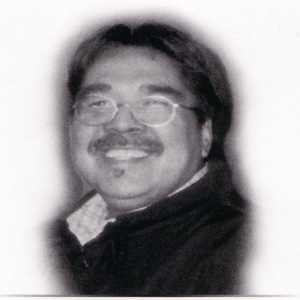
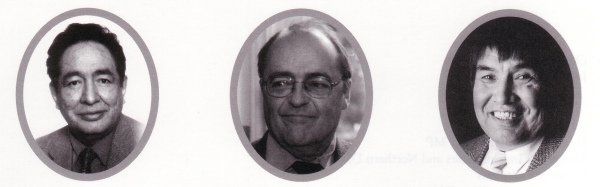
Chief Elijah Einish JUNE 17, 1955-JUNE 28, 2004 |
Mr. Elijah Einish was one of the negotiators for the Naskapi Nation of Quebec in the negotiations with the Government of Canada and the Government of Quebec leading to the execution of the Northeastern Quebec Agreement. He was the translator of the official Naskapi version of the Northeastern Quebec Agreement. Before 2003, Elijah Einish has served the Naskapi Nation of Kawawachikamach as a member of the Council of the Naskapi Nation. He was elected Chief of the Naskapi Nation of Kawawachikamach in August, 2003. The declared objective of Chief Elijah Einish was to promote strength through unity amongst the Naskapi and other First Nations in Quebec and Canada. |
| Mr. Peter John Gull served the Waswanipi Eenouch as Chief and member of the Council of the Cree First Nation of Waswanipi from 1968 to 1986. During his term(s) as Chief, Peter J. Gull was the visionary leader who succeeded in the unification of the Waswanipi Eenouch through the establishment of the new community of Waswanipi. Chief Peter J. Gull was one of the signatories of the James Bay and Northern Quebec Agreement. Mr. Peter J. Gull was also an effective leader for the economic development of Waswanipi. In his many years of involvement with Mishtuk Corporation and Nabaktuk Forest Products, Mr. Peter J. Gull held executive positions such as President, Vice-President and Secretary. |
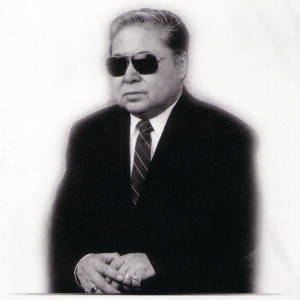
Chief Peter J. Gull JUNE 10, 1943-JUNE 18, 2003 |
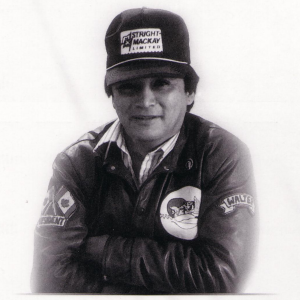
Chief Walter J. Hughboy NOVEMBER 11, 1946-APRIL 2, 2004 |
Mr. Walter James Hughboy served the Wemindji Eeyouch as Chief for a period of twenty-one (21) years from September 1978 to September 1999. Chief Hughboy was a founding member and President of many companies such as Sakami Eeyou Corporation, Tawich Development Corporation, Tawich Construction Inc., Air Wemindji Inc. and many other Eeyou companies. He was an instrumental negotiator in the negotiations respecting the Sakami Lake Agreement, La Grande Agreement and Opimiscow Agreement. Chief Hughboy also played a major role in the economic and community development of Wemindji. Throughout his public life, Chief Walter J. Hughboy was an Eeyou Nation builder. |

 |
WRITERS Richard Saunders, Chairman Philip Awashish, Commissioner DESIGN AND PRODUCTION gordongroup PRINTING Gilmore TRANSLATION George Guanish (Naskapi) Mary Mokoush (Naskapi) C.I.L.F.O. Translation (French) Louise Blacksmith (Cree) PHOTOGRAPHY Edward Saunders Photography John Mameanskum Philip Awashish CONTACT US Cree-Naskapi Commission 222 Queen Street, Suite 305 Ottawa, ON K1P 5V9 telephone: (613) 234-4288 facsimile: (613) 234-8102 toll-free: 1 (888) 236-6603 WEB SITE www.creenaskapicommission.net |

|
THE COMMISSIONERS ARE ALSO GRATEFUL TO THE STAFF OF THE COMMISSION. THE WORK AND CONTRIBUTIONS OF BRIAN SHAWANA, GLORIA DEDAM AND CHARLOTTE KITCHEN HAVE MADE THIS REPORT POSSIBLE. |

|
Ottawa, Ontario June 28, 2004 Hon. Andy Mitchell PC, MP Minister of Indian Affairs and Northern Development House of Commons Ottawa, Ontario K1A 0H4 Dear Minister Mitchell, We are pleased to submit herewith the ninth biennial Report of the Cree-Naskapi Commission pursuant to section 171 (1) of the Cree-Naskapi (of Quebec) Act. This report is based upon hearings and consultations at which the Cree and Naskapi as well as the Government of Canada made known their views, concerns and suggestions relating to the implementation of the Act. We have also reviewed written input from your department and other sources since our last report. We look forward to meeting with you and your officials to discuss appropriate follow up to the findings and recommendations. We shall also be discussing this report with the Cree and Naskapi Nations as well as with other interested parties. Respectfully, Cree-Naskapi Commission |
||
Richard Saunders Chairman |
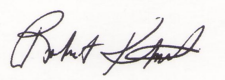
Robert Kanatewat Commissioner |
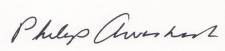
Philip Awashish Commissioner |

 |
||
|
Philip Awashish
Commissionner
Philip Awashish was one of the principal Cree negotiators for the Cree Nation of Eeyou Istchee in the
negotiations leading to the signing of the James Bay and Northern Quebec Agreement. For 20 years, he
has served the Cree Nation of Eeyou Istchee, in various capacities, such as Executive Chief and Vice-Chairman
of the Grand Council of the Crees (of Quebec) and the Cree Regional Authority and Chief and Council of the
Cree Nation of Mistissini.
|
Richard Saunders
Chairman
Richard Saunders holds degrees in Political Science and Public Administration from Carleton University.
He has worked for the Assembly of the First Nations, the Indian Association of Alberta and the Ontario,
Alberta and federal governments. He also serve has Director of Negotiations with the government of Nova
Scotia which in 2002 signed an Umbrella Agreement with the Mi'kmaq Chiefs and the federal government.
Richard was a member of the Cree-Naskapi Commission for three terms from 1986 to 1992. He has been Chairman
since 1997.
|
Robert Kanatewat
Commissionner
Robert Kanatewat, Eeyou from Chisasibi, was instrumental in promoting the awareness of Eeyou rights as an
executive member of the Indians of Quebec Association in the late 1960s and early 1970s. He was the principal
plaintiff in the Kanatewat v. James Bay Development Corporation when the Cree Nation decided to oppose the
initial hydroelectric development in Eeyou Istchee. He was a chief executive involved in the negotiations
leading to the execution of the James Bay and Northern Quebec Agreement. For many years, he has served Eeyou
of Istchee as the Executive Chief of the Grand Council of the Crees (of Quebec), Chief of the Cree Nation
of Chisasibi and in various business enterprises. With the exception of one term, Robert Kanatewat has been
a member of the Cree-Naskapi Commission since 1986.
|

|
MESSAGE FROM THE CHAIRMAN ......................................................................2 CHAPTER ONE Introduction ...............................................................................................................7 CHAPTER TWO Eeyou Local Government and the Cree-Naskapi (of Quebec) Act .............. 11 CHAPTER THREE Concerns and Issues of the Eeyou (Cree) Nation ......................................... 37 CHAPTER FOUR Naskapi Eeyou (Nation) of Kawawachikamach .......................................... 59 CHAPTER FIVE Response of the Department of Indian Affair and Northern Development .64 CHAPTER SIX Recommendations ............................................................................................... 77 CHAPTER SEVEN Conclusion ............................................................................................................. 82 |

|
Reciting the litany of examples of how this problem has affected communities and individuals is unnecessary. The clearest statement of the failure of government policy in relation to "Indian" affairs in general can be found in the 1996 Report of the Royal Commission on Aboriginal Peoples (RCAP) which said:
150 years of policy that was "wrong" not only has had a massive impact on First Nations, it has come to define the culture of the public bureaucracy that has administered the policy and it has produced substantive results at the community, regional and national levels which are taking an extraordinary amount of time and effort to change. If one considers that this 150 years of "wrong" policy has been administered by a centralized bureaucracy which had something approaching the "absolute power" about which Lord Acton was concerned, we begin to see the magnitude of the challenges which face First Nations as they resume their inherent right to self-government as well as a federal government as it moves haltingly, and with occasional misgivings, towards divesting itself of a large part of that nearly absolute power.
CHANGE OF POLICY AND SHIFT OF POWER
|
|
unfettered control over the Cree and Naskapi nations. All of the predictable difficulties and conflicts arose. There were (and still are) disputes about the precise meaning of the provisions of the Agreements. There were (and still are) arguments about the nature and extent of implementation obligations. There was (and remains) a lack of consensus about how the Agreements and the Act mesh with pre-existing and present-day traditional and customary law as well as with broader, constitutionally protected, Aboriginal rights. Those difficulties and conflicts are well documented by the parties themselves, in the transcripts of court proceedings, as well as in previous Reports of the Cree-Naskapi Commission.
IMPLEMENTATION ISSUES The problem is that in many cases appropriate implementation plans were never prepared and that no independent body (other than the courts) exists to oversee implementation, resolve disputes and require accountability from the parties. The Auditor General of Canada has identified this problem on a number of occasions. The September 1998 Report, for example, included the following:
|
|
The proposal of the group (now formed as the Land Claim Agreement Coalition) recommended that a new land claims implementation policy should include the following four elements:
Given the experience of the Cree-Naskapi Commission with implementation issues in Northern Quebec, these recommendations make sense and should be put into effect by the federal government in consultation with the Aboriginal nations concerned. Many of the ideas in the recommendations have in fact been included in the Commission's Reports tabled in Parliament biennially since 1986. What is important today, in 2004, is to know and accept that things have changed, and that the task at hand is to implement the settlement agreements in ways that bring political, economic and social justice to the Cree and Naskapi Nations and their members, and that achieve in full measure the letter, spirit, and intent of the Agreements. In our 2004 Report, the Commissioners report on issues raised by the Cree and Naskapi during the course of the 2004 Special Implementation Hearings as well as in representations filed during the last two years. In addition however, we want to look ahead. Based upon a review of what we have heard, we offer some recommendations, not only in relation to specific concerns identified, but also on future policy directions which we feel may enhance the achievement of the sort of political, economic and social justice which was contemplated by those who signed the Agreements and passed the legislation. |
|
In the area of political justice, we discuss ideas for further recognition, restoration and development of self government. In the area of economic justice, we discuss ideas for greater economic empowerment flowing from fuller participation in the Canadian economy as well as the empowerment which can be achieved through increased access to "own source revenues." In the area of social justice we discuss ideas for improvements to what is commonly called the "social safety net," the administration of justice, and the broad living conditions in the communities.
SELF GOVERNMENT The James Bay and Northern Quebec Agreement and the Northeastern Quebec Agreement committed Canada to the passage of legislation to replace the Indian Act insofar as the Cree and Naskapi were concerned. This commitment resulted in the enactment in 1984 of the Cree-Naskapi (of Quebec) Act. The Agreements and the Act in no way diminished the inherent right of self-government which indeed predated the Agreements, the Indian Act, the Cree-Naskapi (of Quebec) Act (CNA) (and for that matter the arrival of the first European settlers). The Agreements and the Cree-Naskapi (of Quebec) Act acknowledged a greater measure of self-governing authority than had been the case under the Indian Act. Much work however remains to be done to fully acknowledge and implement the restoration of the traditional self-governing powers of the Cree and Naskapi Nations. Certain provisions of the Act are in conflict with traditional and customary laws, which are in all likelihood protected by the Aboriginal rights provisions of section 35 of the Constitution Act 1982. It will be necessary, when considering amendments to the Cree-Naskapi (of Quebec) Act, to eliminate these conflicts. Additionally modern day developments in Cree and Naskapi governance need to be legislatively recognized and/or implemented where appropriate.
ECONOMIC JUSTICE |
|
Despite the existence of substantial difficulties, some real progress has been made. The Agreement signed between the Crees and Quebec in February 2002 to provide indexed funding for a fifty year period for the economic and community development activities of the Crees is a major step forward. It is an example of how the secure long-term funding issue may begin to be addressed. Similar arrangements are needed with the federal government. Canada should immediately begin discussions with the Cree and the Naskapi to identify a process for negotiating a long term resolution of its outstanding economic obligations under the Agreements. The Cree and the Naskapi will also need to identify areas in which they can secure revenues entirely independent from the discretion or input of any other level of government. In some cases, they will need the cooperation of Canada and/or Quebec. Examples could include the implementation of levies, fees and permits in relation to certain activities in their traditional territories.
SOCIAL JUSTICE
CONCLUSION
END NOTES |

Introduction
|
F or the Cree and Naskapi people, there is no more basic principle in aboriginal history and relations than a people's right to govern themselves and their territories in accordance with their traditions, values, goals and aspirations. In particular, mutual recognition of coexisting and self-governing peoples is basic in any continuing relationships with Canada and Quebec. The negotiations, throughout the 1970s, that led to the execution of the James Bay and Northern Quebec Agreement and the Northeastern Quebec Agreement were a rare opportunity for the Cree and Naskapi peoples, respectively, to achieve recognition of particular rights, guarantees and benefits for their distinct societies. These negotiations and subsequent Agreements also provided a means for achieving, to some extent, their vision of self-government for their people, communities and lands but constrained by the existing political and legal environment of the 1970s. The Agreement in Principle, signed on November 15, 1974 by the representatives of the Crees, Canada, Quebec and certain crown corporations provided for 2000 square miles of land as reserves (Category I lands) to the Crees and of which 1274 square miles were to be administered under the Indian Act. In addition, section 16 of the Agreement in Principle stated that the "Band Councils will have certain powers ... in addition to those provided at present by the Indian Act."1 However, the Cree leadership, in the negotiations leading to the final agreement which is the James Bay and Northern Quebec Agreement rejected the restrictive and supervised regime of local government imposed on the Cree bands by the Indian Act.
On November 11, 1975, the James Bay and Northern Quebec Agreement (JBNQA) was signed by the
Grand Council of the Crees (of Quebec), Northern Quebec Inuit Association, Government of Canada,
Government of Quebec and certain crown corporations such as Hydro-Quebec. |
|
Section 9 (Local Government over Category 1A Lands) of the James Bay and Northern Quebec Agreement provides that "there shall be recommended to Parliament special legislation concerning local government for the James Bay Crees on Category 1A lands allocated to them."2 Section 7 (Local Government over Category 1A-N Lands) of the Northeastern Quebec Agreement provides for similar undertakings respecting local government for the Naskapis of Quebec on Category 1A-N lands allocated to them. Consequently, pursuant to section 9 of the James Bay and Northern Quebec Agreement and section 7 of the Northeastern Quebec Agreement, the Cree and Naskapi First Nations and the Government of Canada discussed the terms and provisions of the special legislation concerning local government for the James Bay Crees and the Naskapis of Quebec. This special legislation- the Cree-Naskapi (of Quebec) Act-was enacted by Parliament and assented to on June 14, 1984. The representatives of the Cree and Naskapi parties and the Government of Canada arrived at an understanding as to the implications and impact of the Cree-Naskapi (of Quebec) Act, in the Statement of Understanding of 1984, which is best described as follows:
Thus, the Cree-Naskapi (of Quebec) Act provides "for an orderly and efficient system of Cree and Naskapi local government, for the administration, management and control of Category 1A and Category 1A-N Land by the Cree and Naskapi bands respectively, and for the protection of certain individual and collective under the said Agreements."4 The Cree-Naskapi Commission established by section 158 of the Cree-Naskapi (of Quebec) Act has a duty to "prepare biennial reports on the implementation of this Act"5 to the Minister who "shall cause the report to be laid before each House of Parliament."6 |
However, the James Bay and Northern Quebec Agreement, the Northeastern Quebec Agreement and the Cree-Naskapi (of Quebec) Act are inseparable, to a large extent, and must be considered as a whole in order to capture the intent and spirit of the exercise and practice of Cree and Naskapi local government. In fact, paragraph 21(j) of the Act stipulates that the objects of a band are "to exercise the powers and carry out the duties conferred or imposed on the band or its predecessor Indian Act band by any Act of parliament or regulations made thereunder, and by the Agreements."7 For this reason, the Cree-Naskapi Commission must also consider the implementation of the Agreements in so far as these Agreements contemplate the powers and duties of the Cree and Naskapi First Nations.
Furthermore, pursuant to section 10 of the James Bay and Northern Quebec Native Claims Settlement Act, the legal requirement of the Minister of Indian Affairs and Northern Development to submit an annual report to the House of Commons on the implementation of these Agreements had expired by the end of 1998. Consequently, the Cree and Naskapi Nations are faced with a complete absence of a reporting and monitoring system on the implementation of the James Bay and Northern Quebec Agreement and the Northeastern Quebec Agreement.
Consequently, the Cree-Naskapi Commission is the sole and only remaining body that reports on some aspects on the implementation of the Agreements.
The present report constitutes the ninth biennial report to the Minister pursuant to sub-section 165 (1) and in accordance with sub-section 171 (1) of the Cree-Naskapi (of Quebec) Act.
In the preparation of the present report, the Commission has held Special Implementation Hearings to permit presentation from the representatives of the Cree and Naskapi governments and the Government of Canada.
Consequently, the findings and recommendations as presented in the present report of the Commission are primarily based on the presentations made to the Commission. The tone of the report is determined by what the Commissioners understand is being said by the representatives of the Cree and Naskapi First Nations as well as the representatives of the Department of Indian Affairs and Northern Development representing the Government of Canada.
The Cree-Naskapi Commission has now been, legally, in existence since December 1, 1984. However, the first
Commissioners were not appointed until February, 1986. Nevertheless, the year 2004 represents the 20th
anniversary of the passage of the Cree-Naskapi (of Quebec) Act by parliament. Therefore, the Commission,
in its present report, has prepared a Chapter on Eeyou Local Governments and the Implementation of and
Amendments to the Cree-Naskapi (of Quebec) Act with the hope that the Act will be amended to reflect the
realities, evolution and dynamics of Cree and Naskapi local governments. The rigidity and inflexibility of
certain provisions of the Act without appropriate amendments have been a barrier in the exercise and
practice of Eeyou local government and decision-making for the past 20 years.
END NOTES
- 1 Agreement in Principle (November 15, 1974), section 16
- 2 James Bay and Northern Quebec Agreement - 1997 Edition, Les Publication du Quebec, section 9
(Local Government over Category 1A Lands).- 3 Statement of Understanding of Principal Point Agreed to by the Cree-Naskapi (of Quebec) Act Implementation
Working Group, August 9, 1984. Reproduced in full as Appendix A of the 1986 Report of the Cree-Naskapi
Commission.- 4 Cree-Naskapi (of Quebec) Act, S.C. 1984. C. 46 - preamble
- 5 Ibid., section 165 (1) (a).
- 6 Ibid., section 171 (1).
- 7 Ibid., section 21 (j).
- 2 James Bay and Northern Quebec Agreement - 1997 Edition, Les Publication du Quebec, section 9

Eeyou Local Government and the Cree-Naskapi (of Quebec) Act1
BACKGROUND AND INTRODUCTION
The Eeyou (Cree and Naskapi Nations) have always been self-governing peoples. Indeed, there is no more
basic principle in Eeyou history than the right of Eeyouch to govern themselves and their territories in
accordance with their traditional laws, customs, values and aspirations. It is through their self-governing
nation that Eeyouch express their personal and collective autonomy. The right of Eeyou governance
(Eeyou Tapay-tah-jeh-souwin) is inherent and permanent in the sense that it finds its ultimate origins in
the collective lives, history, traditions and laws of Eeyouch rather than the Canadian Constitution, Treaty
and statutes of Parliament. Nevertheless, the sovereign claims and colonial regimes of the British and
French powers were established in virtual disregard of the fact that Eeyou lands were already occupied and
governed by the Eeyou people. Although the self-governing status of Eeyouch was greatly diminished by the
encroachment of outside governing regimes during the nineteenth and twentieth centuries, it managed to
survive in an attenuated form. Hence, it is important to emphasize that Eeyou governance is not something
that is waiting to happen in the future. It is something that Eeyou have practiced for centuries, and will
continue to practice in accordance with Eeyou law, rights and aspirations.
The Supreme Court of Canada has repeatedly recognized that First Nations were governing themselves when the Europeans arrived. In fact, treaty making with the Crown was, in itself, an exercise of self-government and it implied recognition of the capacity of the First Nations to make treaties with the Crown.
For the recognition and protection of their rights and interests, the Cree and Naskapi peoples negotiated their respective modern day treaties-the James Bay and Northern Quebec Agreement and the Northeastern Quebec Agreement. The Cree and Naskapi view these Agreements or treaties as reaffirmation of their rights and status as a 'nation' and 'people.' They consider also that these Agreements or treaties establish a framework for meaningful and positive relations with the Governments of Canada and Quebec as well as with contemporary society.
Upon the insistence of the Cree and Naskapi (as well as Inuit) leadership, the James Bay and Northern Quebec Agreement and the Northeastern Quebec Agreement have been approved, given effect to and declared valid by legislation of the Governments of Canada and Quebec.
Furthermore and most important, section 35 of the Constitution Act, 1982, recognizes and affirms Aboriginal
and Treaty rights. As far as the Eeyou Nations are concerned, their inherent right to self-government is an
existing right within section 35 of the Constitution Act, 1982.
Consequently, the treaty rights of the Cree and Naskapi peoples under the James Bay and Northern Quebec Agreement
(JBNQA) and the Northeastern Quebec Agreement (NEQA) as well as their aboriginal rights are protected by the
supreme law of Canada.
The Government of Canada, as a policy, recognizes the inherent right of self-government as an existing right within section 35 of the Constitution Act, 1982.2 This inherent right policy is simply a policy and as such does not have force of law. The government can and does deviate from policy and it is in no way legally required to adhere to its policies. The policy limits the subject matters which the government is willing to recognize as part of the inherent right. The policy requires that in all cases, provincial governments are a necessary party to self-government negotiations and agreements where the subject matters being negotiated normally fall within provincial jurisdiction. The policy appears to create a hierarchy of jurisdiction by endorsing the principle that in all cases federal and provincial laws of overriding national or provincial importance will prevail over conflicting Aboriginal laws, but not recognizing as a principle that there are situations which will require that a First Nations law must prevail because of overriding importance to the First Nation. For these reasons, the Commission has some concerns about the inherent right policy of the Government of Canada.
Prior to the implementation of the JBNQA and the NEQA, the Cree and Naskapi peoples were considered governed by and subject to the terms and provisions of the Indian Act and its amendments. The Indian Act provides the Government of Canada with the means to manage the lives and affairs of 'Indians.' As far as the Cree and Naskapi peoples were concerned, the Indian Act severely limited the exercise of the practice and right of Eeyou self-government. Hence, as a means of reaffirmation and gaining recognition of their right of self-government, the Cree and Naskapi leadership, respectively, negotiated section 9 (Local Government over Category IA Lands) and other relevant sections of the JBNQA and section 7 (Local Government over Category IA-N Lands) and other pertinent sections of the NEQA. These sections of the modern day treaties provide for partial expressions of the Cree and Naskapi right of self-government.
Hence the powers of the Eeyou local governments arise both from long-standing practices based upon Eeyou traditional law and customs as well as from the James Bay and Northern Quebec Agreement and the Northeastern Quebec Agreement and the Cree-Naskapi (of Quebec) Act.
Cree-Naskapi (of Quebec) Act
The Eeyou (Cree and Naskapi peoples) wanted to maintain a relationship but a redefined relationship with the Government
of Canada on a basis of the letter, spirit and intent of the terms and provisions of the JBNQA and NEQA as treaties and
the constitutional responsibilities of Canada.
Pursuant to section 9 of the JBNQA and section 7 of the NEQA, respectively, the Government of Canada undertook to recommend to Parliament "special legislation concerning local government for the James Bay Crees on Category IA Lands" and "suitable legislation ... concerning local government for the Naskapis of Quebec on Category IA-N Lands." Consequently, from 1976 to 1984, the Governments of Canada and the Cree and later the
Naskapi negotiated the terms and provisions of this "special and suitable legislation" as well as funding arrangements for its implementation and to establish a redefined relationship with Canada. This special legislation-the Cree-Naskapi (of Quebec) Act-according to its preamble provides "for an orderly and efficient system of Cree and Naskapi local government, for the administration, management and control of Category IA and Category IA-N land by the Cree and Naskapi bands respectively ... "
Except for the purposes of determining which of the Cree and Naskapi beneficiaries are "Indians" within the meaning of the Indian Act, the Cree-Naskapi (of Quebec) Act replaces the Indian Act which does not apply to the Cree and Naskapi First Nations, nor does the Indian Act apply on or in respect of Category IA or IA-N land.
The representatives of the Cree and Naskapi parties and the Government of Canada arrived at a shared understanding as to the implications and impact of the Cree-Naskapi (of Quebec) Act, in the Statement of Understanding of 1984, which is best summarized as follows:
- "The Cree-Naskapi (of Quebec) Act is the cornerstone of the achievement of the full potential of the James Bay and Northern Quebec Agreement and Northeastern Quebec Agreement. The new structures which were created by the Agreements were meant to interface with properly constituted local governments. The Cree-Naskapi (of Quebec) Act is also the basis upon which the relationship with the Federal Government will be redefined. By way of the new Cree-Naskapi (of Quebec) Act, the Cree and Naskapi will be able to go beyond the restrictions inherent in the Indian Act and thereby assume full control in the administration of their communities and management of Category IA and IA-N Lands."
Consequently, the Cree-Naskapi (of Quebec) Act, 1984, is the first legislation in Canada to provide
some recognition of Indian-self-government. It redefines the relationship between the Government of
Canada and the Cree and Naskapi peoples as the Indian Act no longer applies to the Cree and Naskapi
bands and their community lands.
To enable and provide for an orderly and efficient system of Cree and Naskapi local government and for the administration, management and control of Category IA and Category IA-N Lands by the Cree and Naskapi bands respectively, the Cree-Naskapi (of Quebec) Act provides for terms and provisions for the following principal and general matters:
PART I - LOCAL GOVERNMENT
Incorporation of Bands
Membership of Bands
Objects and Powers of Bands
Head Office of Band
Band Council
Council Meetings
Committees of a Council
Band Bodies, Officers, Employees and Agents
By-laws Respecting Local Government
Procedures for Making By-laws and Resolutions
Challenges to By-laws or Resolutions
Transitional Provisions
PART II - BAND ELECTIONS
Entitlement to vote and exceptions for Returning Officer or Assistant Returning Officer
Election By-laws
Eligibility to be Elected and to Serve as Council Member Returning Officers
Calling of Elections
Contestation of Election Results
PART III - MEETINGS AND REFERENDA OF THE BAND
Use of the Cree or Naskapi Language
Ordinary Band Meetings
Special Band Meetings and Referenda
PART IV - FINANCIAL ADMINISTRATION OF BANDS
Fiscal Year and Budgetary Arrangements
By-laws for Preparation and Implementation of Budgets
Books of Account and Financial Records and Statements
Audits
Borrowing Powers of Band
Contracts
Appointment of Administrator
PART V - RESIDENCE AND ACCESS RIGHTS ON CATEGORY 1A AND 1A-N LAND
General Prohibition By-laws respecting Residence and Access Rights Residence Rights Access Rights General
(Special provisions for Naskapi, obstruction and trespass and other remedies preserved)
PART VI - RIGHTS OF BANDS, QUEBEC AND OTHERS IN RELATION TO CATEGORY 1A AND 1A-N LAND
Quebec retains bare ownership of Category IA and IA-N Land Bands exclusive use and benefit of its Category
IA and IA-N and the natural resources thereof Soapstone Deposits Forest Resources Gravel Mineral, Subsurface
and Mining Rights Pre-existing Rights and Interests on Category IA and IA-N Land
PART VII - EXPROPRIATION OF CATEGORY 1A AND 1A-N LAND BY QUEBEC
Expropriating authority of Quebec Expropriation of IA and IA-N Land for public services or structures Band
entitlement to compensation
PART VIII - DISPOSITION OF RIGHTS AND INTERESTS IN CATEGORY 1A AND 1A-N LAND AND BUILDINGS
Grants by band Right of Superficies Subsequent Transfers of Rights or Interests
PART IX - CESSION BY BANDS
Cessions of any of Category IA or IA-N land may be made, but only to Quebec Requirements for valid session
PART X - LAND REGISTRY SYSTEM
Enforceability of rights and interests Regulation for establishment and maintenance of land registry system
Duties of Band
PART XI - EXPROPRIATION BY BANDS
Rights and interests that a Band may expropriate Regulations respecting procedural aspects of expropriation
PART XII - CREE-NASKAPI COMMISSION
Establishment and composition of Commission Appointment of Commissioners Duties of Commission
PART XIII - SUCCESSIONS
Intestate succession Disposition of traditional property on intestacy
PART XIV - TAX EXEMPTIONS
Interpretation and property exempt from taxation
PART XV - SEIZURE EXEMPTIONS
Interpretation and property exempt from seizure Waiver of exemption from seizure
PART XVI - POLICING
Policing jurisdiction Agreements for policing services
PART XVII - OFFENCES
Offences under the Act Contravention of regulations and by-laws Regulations and by-laws for maximum punishment
PART XVIII - ADMINISTRATION OF JUSTICE
Jurisdiction of justices of the peace Summary conviction court
PART XIX - GENERAL
Commissioners of Oaths Certification of documents Admissibility of certified documents
PART XX - CONSEQUENTIAL AMENDMENTS TO OTHER ACTS
Amendment, repeals and substitutions respecting other federal Acts
The Cree-Naskapi (of Quebec) Act was passed by the House of Commons on June 8, 1984. With the exception of Part XII of the Act, the Cree-Naskapi (of Quebec) Act came into force on July 3, 1984. (Part XII of the Act respecting the establishment, duties and operation of the Cree-Naskapi Commission came into effect on December 1, 1984.) Therefore, this comprehensive federal legislation respecting Cree and Naskapi local government has been in force and in effect for about twenty (20) years.
Eeyou Local Government: The Agreements and the Cree-Naskapi (of Quebec) Act
The goal of section 9 of the JBNQA and section 7 of the NEQA was that legislation would be adopted by Parliament
which would provide for Cree and Naskapi local government on their respective communities lands. However, the
inclusion of local governance powers in the treaties was not intended to define Cree and Naskapi governance powers
for all time and the preamble of the Act specifically states that it "is not intended to preclude the James Bay
Crees and the Naskapis of Quebec from benefiting from future legislation or other measures respecting Indian
government in Canada ... ."
The Quebec courts have considered that the powers under the Act are linked to the JBNQA and have interpreted these powers liberally in favour of the existence of autonomous First Nation authority. In 1986, in a judgment dealing with intoxicant laws adopted by the Crees of the Waskaganish First Nation, the Provincial Court of Quebec concluded that:
- "The band council constitutes an autonomous level of government when it exercises powers conferred upon it by the Cree-Naskapi (of Quebec) Act. As long as it remains within the powers so conferred, the band council represents a level of government independent from the Canadian Parliament and the Quebec legislature. Its members are the elected representatives of the community who, in giving them their mandate, invest them with the powers granted to the band under the treaty Convention and especially the Cree-Naskapi (of Quebec) Act. It is to the band members that the council is accountable for its administration and the exercise of its powers, and not to Parliament, of which it is not an agent."3
In another case before the Quebec Provincial Court, this time concerning a curfew by-law of the Cree Nation of Eastmain, the Court concluded that the "the Crees hold some sort of residual sovereignty as regards their local government."4
The challenge and goal of the Cree and Naskapi First Nations are to achieve proper social and economic development and political self-empowerment in the exercise of their rights of self-determination and self-government while protecting their rights, basic freedoms and interests and preserving and maintaining their distinctiveness and cultural identity in accordance with their aspirations and needs.
In this regard, the implementation of the Cree-Naskapi (of Quebec) Act, in letter and spirit, must enable and facilitate
the development and evolution of Cree and Naskapi local government by taking into account the social, economic and political
realities and conditions prevailing from time to time of the Cree and
Naskapi First Nations. Hence, the proper implementation
of the Cree-Naskapi (of Quebec) Act bears exceptional significance and tremendous consequences for the aspirations and goals
of the Cree and Naskapi First Nations as self-governing peoples. The proper implementation of the Act also bears significant
implications on the Government of Canada's treaty obligations to the Cree and Naskapi First Nations.
In particular, Eeyou (Cree and Naskapi) local government must have the following attributes to be "orderly and effective": legitimacy, power and resources. By replacing the Indian Act and through proper implementation of the James Bay and Northern Quebec Agreement and the Northeastern Quebec Agreement, the redefined relationship between the Cree and Naskapi peoples and the Government of Canada must ensure that these elements are properly provided for through legislative and administrative measures. Furthermore, the intent and spirit as well as the letter of Agreements and the Cree-Naskapi (of Quebec) Act must be taken into account to ensure an orderly and effective system of Cree and Naskapi local governments.
The Cree-Naskapi (of Quebec) Act and the Indian Act do not apply to the Ouje-Bougoumou Cree who consequently are not constituted as a separate and distinct band corporation or band under the Acts. Nevertheless, the Ouje-Bougoumou Cree exercise their right of self-government through the Ouje-Bougoumou Eenouch (Nation)-their traditional and historical unit of authority and governance. (Canada undertook in the 1992 Ouje-Bougoumou/Canada Agreement to recommend to Parliament legislation to amend the Cree-Naskapi (of Quebec) Act in order to incorporate the Crees of Ouje-Bougoumou as the ninth James Bay Cree Band and to provide that the new Ouje-Bougoumou Band shall have Category 1A lands.)
The right of self-government inheres in the Cree and Naskapi Nations. Consequently, it is through the nation that the Cree and Naskapi express their personal and collective autonomy. The Eeyou nation is the traditional and historical unit of self-governing power recognized in the treaty-making process and through nation-to-nation and government-to-government relationships.
Furthermore, notwithstanding the legal regime of local government under the Cree-Naskapi (of Quebec) Act, the Eeyouch (Cree and Naskapi people) continue to incorporate their traditions and customs in the exercise and practice of local government.
It must be noted and stressed that the exercise and practice of Cree and Naskapi local government can only be understood if the JBNQA and NEQA and the Cree-Naskapi (of Quebec) Act (CNQA) are read and taken into account as a whole. After all, other sections of the JBNQA and NEQA refer to the jurisdiction and responsibilities of Cree and Naskapi local government and authorities. The spirit and intent of these treaties must also be understood and respected to maintain and improve Cree and Naskapi and federal relations.
The interpretation and implementation of the JBNQA and NEQA and CNQA are partial expressions of the inherent right of
Eeyou self-government. The implicit recognition of the inherent right of Eeyou self-government with viable ways and means
for the proper implementation of self-government in the JBNQA and NEQA and enabling legislation such as the CNQA would
constitute a full expression of the Cree and Naskapi right of local self-government.
Pursuant to section 12 (1) and (2) and section 14 (1) the Cree-Naskapi (of Quebec) Act, the following Cree and
Naskapi Indian Act Bands are separately constituted as corporations and bear the following names:
Great Whale River Band (presently known as the Whapmagoostui First Nation);
Chisasibi Band (presently known as the Cree Nation of Chisasibi);
Wemindji Band (presently known as the Cree Nation of Wemindji);
Eastmain Band (presently known as the Cree Nation of Eastmain);
Waskaganish Band (presently known as the Crees of the Waskaganish First Nation);
Nemaska Band (presently known as the Cree Nation of Nemaska);
Waswanipi Band (presently known as the Cree First Nation of Waswanipi);
Mistissini Band (presently known as the Cree Nation of Mistissini);
Naskapi Band of Quebec (presently known as the Naskapi Nation of Kawawachikamach).
As stated, the Ouje-Bougoumou Cree Nation is not presently incorporated under the Cree-Naskapi (of Quebec) Act yet; but nevertheless exercise an inherent right of local government pursuant to Eeyou law, traditional customs and practices. The meaning and practice of local Eeyou government has evolved and has been redefined over the past twenty (20) years. The Eeyouch are presently using their local governments to address the following needs and exercise jurisdiction in matters such as:
1) Housing
2) Public works
3) Membership
4) Elections and referenda
5) Economic development and enterprises
6) Traditional (hunting, fishing and trapping) pursuits
7) Land administration and local land registry
8) Cultural development
9) Eeyou language development
10) Social development
11) Policing
12) Management and disbursement of Eeyou funds arising from Agreements
13) Resolution of disputes
14) Administration of band funds
15) Eeyou traditional law, values and customs
16) Administration of justice
17) Education
18) Health and social services
19) Preservation and maintenance of culture
20) General welfare of members
21) Youth development
22) Human resources development
23) Training and employment
24) Remedial works (measures to remedy impacts of industrial development)
25) Intergovernmental affairs and relations
26) Provision and administration of programs and services
27) Community development
28) Environmental protection
29) Treaty-making
30) Protection of Eeyou rights and interests
31) Political representation
32) Corporate affairs and relations
33) Nation-to Nation relations
The JBNQA and the NEQA were intended to allow Eeyouch to decide, to a large extent, upon the course of their future, to be a self-sufficient and self-governing people and to play an important role in the development, management and administration of lands and resources within their homelands.
In spite of the improvements that accompanied the negotiation and implementation of the JBNQA, the full potential of local Eeyou government has not yet been realized by Eeyou of Eeyou Istchee. Much of this has to do with the difficulties experienced in the implementation of the Cree-Naskapi (of Quebec) Act and the broader JBNQA. For Eeyou, the proper implementation of this important modern day Treaty is essential for the advancement of Eeyou governance. While progress has been made in the implementation of the NEQA and certain provisions of the JBNQA, essential sections of the JBNQA have been misinterpreted and ignored by the Governments of Canada and Quebec.
Pursuant to its mandate, the Cree-Naskapi Commission has submitted, to date, a total of eight biennial reports to the
Minister of Indian Affairs who tables each report in both Houses of Parliament. The findings of the Cree-Naskapi
Commission pertain to the issues and concerns of the Cree and Naskapi communities relating to the implementation of
the JBNQA, the NEQA and the CNQA. In particular, the Commission recommended appropriate amendments to the Cree-Naskapi
(of Quebec) Act with the objective of enhancing Eeyou local government. In particular and amongst other recommendations,
the Commission has recommended that the inherent right of Eeyou governance and the application of Eeyou traditional
law and customs be recognized and provided for in the amendments to the Act. The Government of Canada, for the most
part, has chosen to ignore the findings and recommendations of the Cree-Naskapi Commission.
The full potential of local self-government, with its dynamic and evolving nature, has not yet been realized
nor achieved by the Cree and Naskapi First Nations because, as one principal constraint, the Cree-Naskapi (of Quebec)
Act, after twenty (20) years, remains an inflexible, rigid and unchanging instrument. (However, the JBNQA is a treaty,
with an evolving character, as it has been amended by means of seventeen Complementary Agreements to meet the needs and
changing conditions of the parties concerned.) Therefore, the Cree-Naskapi (of Quebec) Act, must be amended in order to
provide a flexible framework to accommodate the full range of governmental, administrative and political arrangements
needed and sought by the Cree and Naskapi First Nations and peoples. Such arrangements include the following:
a) flexible legislation with periodic reviews and appropriate amendments;
b) full legitimacy, power and resources to be orderly and effective;
c) redefined relationship between the Eeyou and federal governments; and
d) sufficient resources and appropriate funding arrangements to enable the exercise of effective local Eeyou government.
In addition, Eeyouch and Eeyou leadership envisage the enhancement and advancement of local Eeyou government on the basis of Eeyou rights, goals, needs and aspirations. In particular, the vision for local Eeyou self-government encompasses the following principles, elements and attributes:
a) exercise of right of self-determination;
b) full expression and exercise of inherent right of Eeyou self-government;
c) enhancement of powers and authority;
d) extension of territorial jurisdiction;
e) redefinition of forms and institutions of governance;
f) allocation of adequate resources;
g) establishment of a firm economic base to promote self-sufficiency;
h) clarification and recognition of legitimacy of Eeyou governance;
i) redefinition and establishment of just relationships;
j) establishment of Eeyou-oriented and community-based administration of justice;
k) recognition and affirmation of traditional law and customs;
l) application of Eeyou principles and values;
m) conformity with the present state of aboriginal law; and
n) empowerment of Eeyou.
New Relationship between the Cree Nation of Eeyou Istchee and the Government of Quebec
The signing of the JBNQA did not mark the end of conflicts and disputes with government. Rather it signaled the beginning of continued confrontation between Eeyouch (Cree) and the Governments of Quebec and Canada over the proper implementation of the JBNQA. Over the first quarter century since the execution of the JBNQA, the Cree have engaged in numerous reviews with the Governments of Canada and Quebec regarding the proper implementation of the terms and provisions of the JBNQA. These review processes have resulted in a continuous circle of broken promises as the JBNQA commenced to fall into the long trail of broken treaties. Eeyouch eventually resorted to litigation in defense of their rights as reviews of government obligations and negotiations to resolve disputes over the letter, intent and spirit of the JBNQA have in most cases failed. As a matter of fact, the Cree have initiated or joined in, about thirty lawsuits respecting enforcement of Eeyou rights since 1972. Most of these lawsuits pertain to the failure and refusal of the Governments of Canada and Quebec to honour and fulfill their commitments to Eeyouch of Eeyou Istchee under the JBNQA. In particular, these court proceedings dealt with, amongst other matters, Cree rights under the JBNQA such as the application of the environmental and social protection regime under section 22 of the JBNQA and the requirement for Cree consent on resource development. As they did in the era preceding the negotiation of the JBNQA, these lawsuits helped gain the attention of governments (at least the Quebec government), and contributed to a new round of political negotiations.
The Cree people continue to view their Treaty-the James Bay and Northern Quebec Agreement-as the primary means
of acknowledging and structuring their relationships with the governments of Canada and Quebec. In this regard,
the proper implementation of the letter, intent and spirit of this Treaty is an essential means of maintaining
those relationships over time.
However, from the Eeyou perspective, a relationship among peoples and nations is not a static thing-it
changes and develops in response to new needs and conditions. If constant efforts are not made to negotiate and
update the agreements in terms of which these relationships are embodied and maintained, the relationships themselves
can easily deteriorate and fall apart. With this goal in mind, the Cree Nation of Eeyou Istchee concluded a historic
Agreement with the Government of Quebec. On February 7, 2002, in Waskaganish, Eeyou Istchee, the Grand Council of
the Crees/Cree Regional Authority and the Government of Quebec signed the "Agreement Concerning a New Relationship
Between le Gouvernement du Quebec and the Crees of Quebec." This is a nation-to-nation agreement between Quebec
and Eeyouch of Eeyou Istchee which promises to strengthen political, economic and social relations between Quebec and the Crees.
The New Relationship Agreement marks an important stage in a new nation-to-nation relationship based on openness, mutual respect, an expanded sphere of Cree autonomy, and increased responsibility of the Cree Nation for its own economic and community development. With respect to economic development in particular, the Agreement recognizes an important right of Eeyou to benefit directly from resource development within Eeyou Istchee.
For the period of fifty (50) years commencing from April 1, 2002, Eeyouch assume the obligations of Quebec concerning economic and community development under the provisions of the James Bay and Northern Quebec Agreement. Furthermore, for a period of fifty years commencing on April 1, 2002, Quebec shall pay to Eeyouch an annual amount to enable them to assume these obligations.
The assumption of these obligations with the accompanying financial resources will undoubtedly advance Eeyou governance, since Eeyou local and regional governments will now exercise power and jurisdiction over the social and economic development of their own communities. In fact, particularly over the past three decades, Eeyou governments have already been exercising such powers and jurisdiction for economic and community development. The New Relationship Agreement simply formalizes these arrangements and provides them with a more secure funding base.
The New Relationship Agreement does not affect the obligations of the Government of Canada to Eeyouch under the JBNQA. Moreover, it remains to be seen whether Canada intends to follow the lead of Quebec in fulfilling its obligations to Eeyouch of Eeyou Istchee in a manner which addresses the spirit and intent of the JBNQA and which sets an acceptable standard of the nation-to-nation relationship between Eeyouch and Canada. Up to now, the Government of Canada has demonstrated neither good faith nor the political will to do so.
The leadership of the Cree Nation of Eeyou Istchee has stated to the Commission that the Government of Canada should
establish a similar relationship with Eeyou of Eeyou Istchee through negotiations and a similar agreement respecting
Canada's obligations to the Crees under the JBNQA. Therefore, a redefined relationship between the Eeyou and
federal governments must, amongst other obligations, adequately affirm, recognize and provide for legitimacy,
power and resources for orderly and effective local and regional Eeyou government.
However, Grand Chief Ted Moses states that "to date, DIAND has been incapable of articulating a coherent
response to the new political, legal and financial situation resulting from the new agreement between the Cree Nation and Quebec."5
Implementation of the Cree-Naskapi (of Quebec) Act
Over the past twenty (20) years (since the enactment and proclamation of the Cree-Naskapi (of Quebec) Act, the
Commission has identified, from the Eeyou Nations, the most serious issues and concerns respecting the implementation
of the Act as follows:
1. Duties and Responsibilities of the Government of Canada
By enacting the Cree-Naskapi (of Quebec) Act pursuant to treaty obligations, the Government of Canada assumed
certain duties and responsibilities for the proper administration and implementation of the Act. (The Cree and Naskapi
local governments also assume certain duties and responsibilities for the proper implementation of the Act.)
Since its enactment by Parliament in 1984, the implementation, in letter as well as the spirit and intent, of the Cree-Naskapi (of Quebec) Act, has not been conducted, in a manner, that recognizes, enhances and enables the present state, practice and full potential of Cree and Naskapi local self-government.
The proper implementation of the Cree-Naskapi (of Quebec) Act was not anticipated to be an easy and simple process.
In the first place, it was the Cree and Naskapi peoples who had the political will and vision to demand and initiate
the change of local government from the restrictive legal regime of the Indian Act to that of the Cree-Naskapi (of Quebec)
Act as contemplated in the James Bay and Northern Quebec Agreement and the Northeastern Quebec Agreement. Therefore, the
Cree and Naskapi peoples expect the Government of Canada to find the political will and provide legislative and
administrative as well as financial measures necessary for the advancement and completion of this change. In many
ways, this change involves the redefinition of relations between the Government of Canada and the Cree and Naskapi
(First) Nations. To a large extent, the proper and successful implementation of the Cree-Naskapi (of Quebec) Act has
been hindered by the absence of an understanding or agreement on the nature of relations that should exist between
Canada and the Cree and Naskapi peoples.
James Bay and Northern Quebec Agreement and the Northeastern Quebec Agreement. Therefore, the
Cree and Naskapi peoples expect the Government of Canada to find the political will and provide legislative and
administrative as well as financial measures necessary for the advancement and completion of this change. In many
ways, this change involves the redefinition of relations between the Government of Canada and the Cree and Naskapi
(First) Nations. To a large extent, the proper and successful implementation of the Cree-Naskapi (of Quebec) Act has
been hindered by the absence of an understanding or agreement on the nature of relations that should exist between
Canada and the Cree and Naskapi peoples.
The Cree-Naskapi (of Quebec) Act establishes government-to-government relations and imposes
responsibilities and obligations upon the Government of Canada as a whole and not solely upon the Department of Indian Affairs and Northern Development for the normal and primary means of implementation of the Cree-Naskapi (of Quebec) Act. However, meaningful and productive government-to-government relations are essential and necessary with the Government of Canada as a whole and not solely with DIAND which lacks the structure and resources to effectively coordinate interdepartmental interests and responsibilities for the proper implementation of the Cree-Naskapi (of Quebec) Act. The Report of the Auditor General of Canada to the House of Commons for the fiscal year ended, March 31, 1986, confirms the latter point. The government-to-government relations have, from time to time, been confrontational and adversarial. However, these relations have forged agreements, after difficult and strenuous negotiations, for the benefit and interests of the Cree and Naskapi local governments. But, the partnership of Canada and the Cree and Naskapi First Nations must be renewed with the Government of Canada as a whole. Furthermore, the purpose of the Act should assert the obligations of Canada for effective government-to-government relations.
The Cree-Naskapi (of Quebec) Act does not, specifically, establish a process for its proper implementation. In the absence of such a process, general responsibility for the proper implementation of the Cree-Naskapi (of Quebec) Act was assumed by the Department of Indian Affairs and Northern Development (DIAND). This assumption of general responsibility by the DIAND has resulted to both positive and negative consequences for the implementation of the Cree-Naskapi (of Quebec) Act. Nevertheless, the Cree-Naskapi (of Quebec) Act should be amended to provide for a meaningful, periodic and effective process of review and implementation of the Act with the direct participation of the Cree and Naskapi parties. This periodic review should include the assistance of the Cree-Naskapi Commission.
Typically, the process of implementation, as in the case of the Cree-Naskapi (of Quebec) Act, has been that parliament enacts legislation and its administration and implementation remains the responsibility of the Minister of Indian Affairs and Northern Development. At best, there are a few questions of organization such as the present James Bay Implementation Office. Throughout this traditional form of implementation, the Cree and Naskapi peoples are denied a meaningful role in the decision-making process even though they (the Eeyouch) are most impacted by the application, administration and implementation of the Cree-Naskapi (of Quebec) Act. The conventional style of implementation is frequently insensitive to the actual needs and aspirations of the Cree and Naskapi peoples and has resulted in symbolic implementation that amounts to no real change in how decisions are made and in how things are done.
The proper and successful implementation of the Cree-Naskapi (of Quebec) Act is an integral part of the political process in which the duties and responsibilities of the federal, Cree and Naskapi (local) governments, as well the Cree Nation regional authorities, should be clarified and agreed upon by the parties.
2. Operations and Maintenance (O & M) Funding
To be consistent with the spirit and intent of the James Bay and Northern Quebec Agreement and the Northeastern Quebec
Agreement and, in particular, the Cree-Naskapi (of Quebec)Act, in 1984, the representatives of the Government of Canada,
the Cree and Naskapi governments and authorities concluded an understanding on a mechanism for the funding of Cree and
Naskapi
local governments and administration. The Government of Canada later refused to accept the Statement of
Understanding as a binding agreement. The disagreement over the Statement of Understanding led to confrontation,
litigation, negotiations and eventually to a mediated settlement.
In particular, the parties agreed that the Government of Canada would provide an ongoing operations and maintenance subsidy to support the exercise of local government for the Cree and Naskapi peoples. The present 'Operations and Maintenance Funding Transfer Payment Agreements' provides for an annual operations and maintenance subsidy for the Cree and Naskapi local governments as well as regional administration for the Cree.
These transfer payment agreements usually provide for an annual subsidy for a period of five (5) years after which new agreements are negotiated. However, the Government of Canada continues to insist on funding agreements that fail to take into account the evolving needs and realities of Eeyou self-government. Under these funding agreements, the Crees and Canada were to review the agreement and funding formula to take into account the evolving needs and matters that were not anticipated in the original funding agreement. This review has not happened in an acceptable manner as Canada has simply extended the application of the previous funding agreement with an adjustment for funding.
The Cree local governments have expressed the following main concerns respecting the 'Operations and Maintenance (O & M) Funding Transfer Payment Agreement':
a) The Government of Canada has, allegedly, failed to comply with important and essential provisions of the O & M funding agreement;
b) The Government of Canada has not exercised its fiduciary responsibility, in a manner to protect the interests of the Eeyouch;
c) Canada has refused to review the current situation, changing circumstances and needs of the Cree even though such a review is provided for by the said funding agreement; and
d) The funding levels or criteria for the base year, as established in 1984, must be reviewed and revised to reflect the present circumstances, reality and needs of the Cree local
governments and administration.
Earlier in the present chapter, resources have been identified as one essential attribute for an effective and orderly government. Therefore, sufficient funding and satisfactory financial arrangements must be in place to enable the effective exercise of local government.
The Cree party has expressed difficulties in implementing and renewing these financial arrangements every five (5)
years. It is time for a redefinition of the fiscal relations with a new financial arrangement that will definitely
comply with Treaty obligations and support effective, orderly and meaningful self-government in accordance with the
needs and aspirations of the Eeyouch.
3. Capital Projects and Community Development
In spite of Canada's obligations to Eeyou under the JBNQA and in spite of these needs of the Eeyou communities, capital
projects negotiations and agreements on funding arrangements have led to demands from the Government of Canada for an
outright release from treaty obligations and commitments. As an example, Canada insists on such an outright release
with respect to fire protection after the Crees have received some federal funding. As far as Eeyouch are concerned,
the Government of Canada must respect and honour its obligations to Eeyouch to fund fire protection and capital
projects such as housing and community infrastructure as long as the JBNQA is in force.
4. Bill C-23 (An Act to Modernize the Statutes of Canada in Relation to Benefits)
Due to a decision of the Supreme Court of Canada, the Government of Canada has tabled and enacted Bill C-23-legislation
respecting the rights of same sex couples and benefits. Bill C-23 requires amendments to the definitions of 'consorts'
in section 174 of the Cree-Naskapi (of Quebec) Act.
The Cree and Naskapi Nations have taken the position that the Government of Canada cannot unilaterally amend the pertinent section of the Cree-Naskapi (of Quebec) Act. By virtue of the James Bay and Northern Quebec Agreement and the Northeastern Quebec Agreement, such amendments to the Act require agreement with the Cree and Naskapi parties. The concern is therefore with the failure to respect the amendment process rather than with the substance of the amendment.
5. Cree-Naskapi Commission
In the absence of a comprehensive process for the proper and successful implementation of the Act, the Cree-Naskapi
Commission has duties to prepare biennial reports on the implementation of the Act and to investigate any representations
submitted to it relating to the implementation of the Cree-Naskapi (of Quebec) Act. The biennial report is submitted to
the Minister of Indian Affairs and Northern Development who causes the report to be laid before each House of Parliament.
In virtue of section 165 (1) (b) of the Cree-Naskapi (of Quebec) Act, the Commission has the duty to "investigate any
representation submitted to it relating to the implementation of the Act, including representations relating to the
exercise or non-exercise of a power under this Act and the performance or non-performance of a duty under this Act."
Furthermore, section 21, (j) of the Act states that one of the powers and objects of the Bands is "to exercise the
powers and carry out duties conferred or imposed on the band or on its predecessor Indian Act band by any Act of
Parliament or regulations made thereunder, and by the Agreements." (Emphasis by the Commission)
The James Bay and Northern Quebec Claims Settlement Act-an Act of Parliament-approves, gives effect to and declares
valid the James Bay and Northern Quebec Agreement. Pursuant to this Act, the Governor-in-Council, by order, approved,
gave effect to and declared valid the Northeastern Quebec Agreement.
Consequently, the Cree-Naskapi Commission considers that it has, at least, the duty and responsibility to report on the implementation of the Agreements, in so far, as these Agreements relate to the exercise of a power and performance of a duty of the Cree and Naskapi local governments.
The Department of Indian Affairs and Northern Development (DIAND) does not concur with this particular interpretation of the duty of the Commission.
The Eeyou governments have often stated that the Commission should continue to report on the implementation of the James Bay and Northern Quebec Agreement.
Since the coming into force of Part XII of the Act, the Cree-Naskapi Commission has produced eight (8) reports on the implementation of the Cree-Naskapi (of Quebec) Act and, to some extent, on the implementation of the James Bay and Northern Quebec Agreement and the Northeastern Quebec Agreement. As the findings and recommendations of the past reports of the Commission have been effectively, to a large extent, ignored by the DIAND, these findings and recommendations have had no bearing, impact or influence in the decision-making and policy-making processes of the Government of Canada in a manner that recognizes, enhances and enables the present state, practice and full potential of the Cree and Naskapi local governments.
However, the findings and recommendations of the Cree-Naskapi Commission as stated in the 1998 Report are supported, in principle, by resolutions of the members of the Grand Council of the Crees (Eeyou Istchee) and the Naskapi Nation of Kawawachikamach. Furthermore, the members of the Cree Nation of Eastmain, at their 1999 Local Annual General Assembly, adopted a resolution that extends full support to the recommendations of the 1998 Report of the Cree-Naskapi Commission. These resolutions are authoritative and consequently should be respected through appropriate actions and measures by the Government of Canada.
Currently, the Cree-Naskapi Commission, itself, suffers from a lack or absence of a proper and effective implementation mechanism. This fact that there is no present mechanism to ensure the proper implementation of the recommendations of the Cree-Naskapi Commission is a cause for some concern.
Commissions are important instruments of policy-making. Their aim has been to achieve more widespread public understanding
of the questions at issue and a more informed basis for policy choices by the decision-makers.
Part I of the Inquiries Act governs the Commissions with a high profile such as Royal Commissions and task forces which are temporary organizations created to investigate specific incidents or general policy concerns and report to government. They are usually dismantled after the delivery of their report and so are not involved in the implementation of any of their recommendations.
However, the Cree-Naskapi Commission was established by special federal legislation- Cree-Naskapi (of Quebec) Act-which was enacted by Parliament pursuant to treaty obligations under the James Bay and Northern Quebec Agreement and the Northeastern Quebec Agreement.
As most of the recommendations of the Commission concern the implementation of the Cree-Naskapi (of Quebec) Act, the Government of Canada is faced with major policy issues respecting the exercise of Cree and Naskapi local government. Consequently, the right and exercise of Aboriginal (Cree and Naskapi) self-government is clearly a major issue that requires study and policy advice. However, the recommendations of the Cree-Naskapi Commission are only truly relevant when they are properly and successfully implemented in a manner that meets the needs and aspirations of the Cree and Naskapi local governments. Because the Government of Canada appears to be engaged in a process of institutionalized delay on the question of the right and exercise of Aboriginal self-government, the Cree-Naskapi Commission has seemingly become irrelevant to the policy and decision-makers of government.
Therefore, the question of the relevance or irrelevance of the Cree-Naskapi Commission in the decision-making
as well as policy-making processes respecting the implementation of the Cree-Naskapi (of Quebec) Act must be
addressed, more so, after about twenty (20) years of existence of the Commission.
During the discussions, in 1975 to 1984, with the representatives of the Government of Canada on
terms and provisions of the Cree-Naskapi (of Quebec) Act, the Cree party envisaged a process in which the
effectiveness of the Cree-Naskapi Commission would be reviewed.
Therefore, pursuant to section 172 (1) of the Cree-Naskapi (of Quebec) Act, after an initial period of 5 years of operation of the Commission, an independent Inquiry was established to inquire into the powers, duties and operation of the Cree-Naskapi Commission.
The Report of the Inquiry into the Cree-Naskapi Commission was submitted to the Minister of Indian Affairs and Northern Development in April, 1991.
In their letter of submission of their report dated April 4, 1991, the members of the Inquiry into Cree-Naskapi Commission state:
- "It is our hope that this report will provide a basis for the Cree, the Naskapi and the Federal Government to work co-operatively together to achieve agreement on the future of the Commission in such a way as to ensure that this body, which is unique in Government-Aboriginal relations in Canada, is better able to serve the common interests of the parties to Canada's first legislation recognizing Indian self-government."6
Thirteen (13) years have elapsed since the submission of the Report of the Inquiry into the Cree-Naskapi Commission. The status quo remains as the Government of Canada has seemingly ignored the recommendations of the Inquiry into the Cree-Naskapi Commission.
Furthermore, the members of the Grand Council of the Crees (Eeyou Istchee)/Cree Regional Authority and the Naskapi Nation of Kawawachikamach, at their respective 1999 Annual General Assembly, adopted resolutions which provide that the powers, duties and operations of the Cree-Naskapi Commission be reviewed and appropriately revised by the Governments of Canada, Cree Nation and Naskapi Nation (of Kawawachikamach) by taking into account the experiences of the Cree-Naskapi Commission, Cree and Naskapi local governments and the findings and recommendations of the 1991 Inquiry into the Cree-Naskapi Commission. In a letter, dated March 16, 2000, addressed to the present Chairman of the Commission, the Minister of Indian Affairs and Northern Development responds to these Cree and Naskapi resolutions in the following way:
- "I note from your letter that the Cree and Naskapi General Assemblies have suggested
revising the powers and duties of the Cree-Naskapi Commission. While the
Commission currently plays an important role in reporting on the implementation of
the Cree-Naskapi (of Quebec) Act, as well as investigating representations based on
the Act, the federal government does not foresee, at this time, making any revisions
to the mandate of the Cree-Naskapi Commission. I feel that such revisions should
only be considered in the context of a much broader initiative aimed at redefining
self-government for the Cree and/or Naskapi."
Consequently, as far as the federal government is concerned, any revisions to the current mandate of the Cree-Naskapi Commission should only be considered in the context of a much broader initiative aimed at redefining self-government for the Cree and/or Naskapi.
Amendments to the Cree-Naskapi (of Quebec) Act
In the preparation of its biennial reports on the implementation of the Cree-Naskapi (of Quebec) Act, the Cree-Naskapi Commission has conducted public consultations with the Government of Canada, Cree and Naskapi First Nations and other interested parties as part of its fact-finding procedures. In addition, the Commission has prepared discussions papers on the implementation and amendments to the Cree-Naskapi (of Quebec) Act as well as investigation reports in response to certain representations made with regards to band elections. Based on its findings and conclusions, the following general issues and concerns require immediate attention by Canada for possible amendments to the Cree-Naskapi (of Quebec) Act in order to enhance the exercise of local Cree and Naskapi self-government:
A. Eeyou (Cree and Naskapi) Issues
The Cree and Naskapi representatives made the following principal comments and recommendations respecting the implementation of and amendments to the Cree-Naskapi (of Quebec) Act and the exercise of Eeyou self-government:
1) The implementation of the Cree-Naskapi (of Quebec) Act set up relations between the Cree nation consisting of nine communities and the Government of Canada.
2) The right of Eeyou to govern is in only a small way expressed in section 9 of the JBNQA and partially expressed through the Agreement.
3) The inherent right of Eeyou people to govern is however much more than what is set out in section 9 or indeed in the whole Agreement.
4) The preamble in the Cree-Naskapi (of Quebec) Act affirms that the Cree would not be limited by the Act in the future and could benefit "from legislative or other measures respecting Indian Government in Canada that are not incompatible with the said Agreements."
5) The terms and provisions of the Cree-Naskapi (of Quebec) Act must evolve and be consistent with the present situation, needs, aspirations and reality of Eeyou local government.
6) The Ouje-Bougoumou Eenouch (Cree) must be incorporated into the James Bay and Northern Quebec Agreement by way of a Complementary Agreement and consequently be incorporated as the Ouje-Bougoumou Eenouch through appropriate amendments to the Cree-Naskapi (of Quebec) Act.
7) The role of the Cree-Naskapi Commission must be more effective in the resolution of disputes, issues and grievances. The Commission must be more independent and its decisions should be binding on the parties concerned.
8) The modernization of the Cree-Naskapi (of Quebec) Act remains an outstanding issue.
9) The provisions of the Cree-Naskapi (of Quebec) Act must be clarified and/or amended for the
following matters:
a) Accountability of the local authorities and officials to the local electorate;
b) Duties of the Chief and Deputy Chief;
c) Powers of Chief and Council as determined by the Cree Nation;
d) Manner of enactment of legislation such as by-laws and regulations;
e) Meetings of the Council;
f) Transitional process of authority with a change in leadership;
g) General meetings;
h) Rules of conflict of interest;
i) Roles and duties of the Band Secretary and Treasurer;
j) Financial administration; and
k) Recognition of a Cree National Government as well as the Grand Council of the Crees (Eeyou Istchee) and the Cree Regional Authority.
10) Financial resources are needed for the implementation of by-laws.
11) As a local government with delegated authority only, the authority of the Band Corporation must be expanded to enable the enactment of by-laws that respond to community needs.12) The provisions of the Cree-Naskapi (of Quebec) Act relating to 'Eligibility to be Elected and to Serve as Council Member' should be amended to prohibit officials such as the Director of Operations and Executive Director of the Band Corporation from holding public elected office of the Band Corporation.
13) The amendments to the Cree-Naskapi (of Quebec) Act desired by the Naskapi Nation of Kawawachikamach include the following:
a. lowering certain quorums
b. permitting law enforcement officers to issue tickets rather than summonses to offenders of Naskapi Nation by-laws
c. enabling Council to conduct business without calling a meeting in certain circumstances.
14) The tax exemption provisions in the Cree-Naskapi (of Quebec) Act require clarification and expansion to include all beneficiaries of the James Bay and Northern Quebec Agreement and wholly owned 'band,' bodies, entities or Corporations.
15) The powers of the Band should be expanded and specific for local sustained economic development.
16) The Act should be updated for a more flexible system which allows for the waiver of the exemption from seizure of certain property located on Category IA lands, in order to provide increased commercial financing options for local businesses.
17) The Cree Nation of Eastmain should have the power to establish its own requirements for quorums
in the public decision-making process.
18) The Cree-Naskapi (of Quebec) Act should be amended to ensure that the Cree Nation of Eastmain has as many implements as possible available to ensure that the resources necessary to its proper functioning are always available for the exercise of true self-government.
19) The powers of the Cree Nation of Eastmain to tax should be clarified and expanded as an attribute for local government finance.
20) The legislative powers of the Band should be clarified particular in respect to the general application or non-application of provincial laws.
21) The Cree Nation of Eastmain should have legislative authority to establish control and administer the local Land Registry System.
22) The Cree-Naskapi (of Quebec) Act should be amended to provide for the payment to the Cree Nation of Eastmain of fines levied and collected for violation of certain by-laws, as well as for tickets issued for violation of traffic regulations, preferably not only on Category IA lands, but on all Category I and II lands that are part of the Eastmain Access Road from the Matagami-LG2 highway.
23) The Cree Nation, through the Grand Council of the Crees (Eeyou Istchee/Cree Regional Authority) should develop, establish, and implement a national standard or law on all matters respecting elections. This standard or law on elections would be adopted by the Cree Nation and replace provisions on elections contemplated by the Cree-Naskapi (of Quebec) Act.
24) The Land Registry System and process should take into account the Cree way of life and traditions. The Cree land registry system should be recognized and fully implemented as the federal government is trying to impose the federal land registry system upon the Cree Nation.
25) The Cree Nation of Eeyou Istchee should proceed with a complete and thorough review of:
- a. the application of the Cree-Naskapi (of Quebec) Act since its implementation in 1984;
b. the role of the Cree-Naskapi Commission; and,
c. the role of the Federal Government.
26) In order to assist in the implementation of the James Bay and Northern Quebec Agreement and provide good government, the Cree local governments should have additional and expanded powers.
27) The officials of the local government lack institutional support in order to carry out their duties and responsibilities.
B. Local Government Elections
Over the past years, most of the representations made by Eeyou individuals, pursuant to section 165 (b)
of the Cree-Naskapi (of Quebec) Act, relate to local government elections. In addition to the particular
investigation reports submitted to the individuals, officials and authorities concerned, the Cree-Naskapi
Commission has, as stated, produced a discussion paper entitled 'Local Government Elections of the Cree and
Naskapi (First) Nations,' dated September 22, 1999.
The said discussion paper which includes the recommendations of the Commission is available on the Web site of the Commission.
Since the establishment of the Cree-Naskapi Commission, the Commission has received representations respecting the regulation and conduct of band elections from certain Eeyou individuals. It has been the Commissioners' experience that these representations have revealed substantive concerns with the existing electoral arrangements. More specifically, this includes concerns about the election provisions of the Act itself, concerns about By-law provisions, concerns about application of traditional law and customs as well as the practices surrounding the conduct of elections and contestation of election results.
C. Other Issues and Concerns
Furthermore, the Cree-Naskapi Commission has also produced a discussion paper- 'Implementation of and Amendments to the Cree-Naskapi (of Quebec) Act.' Based on its findings and conclusions and submissions of the Cree and Naskapi Nations, the following matters constitute the major issues and concerns respecting the implementation of and amendments to the Cree-Naskapi (of Quebec) Act as described in the said discussion paper:
a) federal fiscal policy and funding
b) government-to-government Relations
c) public forums and quorums for decision making
d) police and enforcement
e) administration of justice
f) powers and jurisdiction of governments
g) implementation of the James Bay and Northern Quebec Agreement and the Northeastern Quebec Agreement
h) powers, duties and operation of the Cree-Naskapi Commission
i) incorporation of the Ouje-Bougoumou Cree Nation
j) application of Eeyou traditional laws and customs
k) process of amendments to the Acts
l) membership and names of First Nations
m) legislative authority of Cree and Naskapi local governments respecting the following:
- Land Registry System
- Band Elections
- Conflicts of Interest
- Code of Ethics
- Challenges to By-laws or Resolutions
- Trade and Commerce
- Operation of Councils of Local Government
- Cultural Activities
- Power of Entry
- Outstanding Accounts
n) taxation
o) prevailing authority of by-laws
p) implementation of the federal firearms legislation
q) seizure exemptions
r) financial administration of Bands
s) mineral, subsurface and mining rights
t) jurisdiction over certain parcels of Category II lands
u) payment of fines
v) traffic ticket system
w) by-law powers pursuant to the James Bay and Northern Quebec Agreement and the Northeastern Quebec Agreement
x) local environment administrators
y) authority of Cree tallymen and conservation officers
z) benefits of future legislation and other measures respecting Indian Government.
For details on these matters, the discussion paper of the Commission on the implementation of and amendments to the Cree-Naskapi (of Quebec) Act is available on the website of the Commission. These matters for consideration as possible amendments to the Cree-Naskapi (of Quebec) Act are also supported in principle by the Cree and Naskapi peoples and governments.
CONCLUSION
Eeyou-federal relations need to be clarified and in some cases redefined by Eeyou and Canada to ensure an orderly
and effective system of Eeyou local government in accordance with the vision, needs and aspirations of the Eeyou Nations.
Based upon the findings and conclusions of eight biennial reports, two discussion papers and certain
investigations of the Cree-Naskapi Commission, it is definitely and essentially clear that the Cree-Naskapi
(of Quebec) Act should be reviewed and amended to provide for an orderly and efficient system of Cree and Naskapi
local government, for the administration, management and
control of Category IA and Category IA-N land by the Cree and Naskapi bands respectively consistent with the
present practice of Eeyou governance and the present state of aboriginal law and Eeyou traditional law.
Consequently, and in conclusion, a meaningful process must be established and implemented by the Governments of Canada, Cree and Naskapi peoples for a full and comprehensive review of the Cree-Naskapi (of Quebec) Act with the objective of identifying and determining appropriate amendments to the special federal legislation respecting Cree and Naskapi local government. This process must include a clear undertaking that the Government of Canada shall amend the Cree-Naskapi (of Quebec) Act, in a manner, that recognizes, enhances and enables the present state and exercise and full potential of Cree and Naskapi local self-government.
END NOTES
1 This Chapter is an update, integration and summary of discussions papers prepared by the Cree-Naskapi Commission
as well as Chapter 8 of the 2000 Report of the Commission. The discussion papers, available on the Web site of the
Commission, are entitled 'Implementation and Amendments of the Cree-Naskapi (of Quebec) Act' and 'Local Government
Elections and the Cree-Naskapi (of Quebec) Act.'
2 Aboriginal Self-Government. The Government of Canada's Approach to Implementation of the Inherent Right and
the Implementation and the Negotiation of Self-Government, Federal Policy Guide, Indian and Northern Affairs Canada.
3 Waskaganish Band v. Blackned [1986] 3 C.N.L.R. 168 at 187.
4 Eastmain Band v. Gilpin [1987] 3 C.N.L.R. 54 at 67.
5 Grand Council of the Crees (Eeyou Istchee) - Submission to the Cree-Naskapi Commission - Montréal, Quebec -
February 12, 2004, p. 8. 6 Letter from members of the Cree-Naskapi Commission Inquiry, dated April 4, 1991, addressed
to the Hon. Thomas E. Siddon, Minister of Indian Affairs and Northern Development.

Concerns and Issues of the Eeyou (Cree) Nation
On February 10, 11 and 12, 2004, as well as on February 23, 2004, the
Cree-Naskapi Commission held Special Implementation Hearings in Montréal, Quebec in order to permit the
representatives of the Cree, Naskapi and Federal governments to make presentations to the Commission in
preparation for its present report.
Consequently, this Chapter on the concerns and issues of the Eeyou (Cree) Nation must be read in conjunction with Chapter 5 respecting the responses of Indian and Northern Affairs Canada to the 2002 Report of the Cree-Naskapi Commission as outlined in the said Department's presentation to the Commission on February 10, 2004.
1. Grand Council of the Crees (Eeyou Istchee)
Grand Chief Ted Moses and Mr. Bill Namagoose made a presentation1 to the Commission on February 12, 2004,
the Grand Chief and other representatives of the Grand Council presented the following comments and concerns:
A. The Cree-Naskapi (of Quebec) Act in the Context of the James Bay and Northern Quebec Agreement
According to the representatives of the Grand Council, the James Bay and Northern Quebec Agreement (JBNQA) was signed by the Crees in the belief that a new era of Cree governance had begun with the elimination of paternalism and colonialism and the beginning of a new relationship with Canada and Quebec. The Cree Project beginning with the recognition of Cree governance would evolve with timely and effective implementation of the JBNQA. However, this implementation did not occur in accordance with the intent and spirit of the JBNQA.
The Government of Canada has given its obligations to the Crees a very narrow interpretation which seriously undermines community services and community development such as housing and other capital projects such as fire protection equipment and facilities and essential services.
In a letter dated November 15, 1974 and addressed to Chief Billy Diamond, Minister Judd Buchanan states as follows:
- "With respect to Clause 7 of the said Agreement in Principle. Canada undertakes, in particular, that programs and funding for education, housing, and health, will continue to apply to the James Bay Crees ... without discrimination to the said Crees ... because of the benefits, or privileges arising from the Final Agreement ... "2
Clearly, as far as the Grand Council of the Crees is concerned, the Crees were assured that community development
including housing would be given a wider perspective in the implementation of the Final Agreement (which is known
as the James Bay and Northern Quebec Agreement).
On February 10, 2004, Mr. Michel Blondin, Director of the James Bay and Northern Quebec Implementation
Office, in a presentation to the Commission stated the following:
- "The lack of adequate housing is indeed a serious issue in most Cree and Naskapi communities, as it is in most Northern Indian communities across the country. The impacts of the housing situation are profound and far reaching. However, there is an additional complication in the case of the Cree, in that they have often asserted a special right to housing under the JBNQA. Canada disagrees; but I will assure that they will have access to the federal housing programs as the other Indians on reserves across Canada."3
The Grand Council continues to state that the short-sightedness and the lack of political will of governments have caused the current implementation deficit which is "the extent to which the Cree development has been delayed since 1975 by governments that have not been guided by the aim of the treaty: the economic and social development of the Cree People."4
According to the Grand Council, the Crees (not counting the Washaw Sibi Eeyou) are currently short about 1400 houses and another 1190 units will be needed over ten years. The cost of resolving the housing backlog, constructing new units, completing renovations and installing the necessary infrastructures for the new houses is approximately $623 million.
Furthermore, with the exception of Eastmain which has been promised forth-coming funds, the Government of Canada has not contributed to the funding of community centres as contemplated in sub-section 28.11 of section 28 of the JBNQA. The construction or provision of a community centre in each Cree community (excluding Washaw Sibi) would cost an additional amount of about $210 million. (On March 11, 2004, Mr. Michel Blondin, Director, James Bay Implementation Office, informed the Commission that the Cree Nation of Eastmain, Cree Regional Authority and Canada have finalized the agreement to fund an amount of $3.2 million towards the Eastmain Community Center. Chief Edward Gilpin of the Cree Nation of Eastmain has confirmed receipt of the payment for the Eastmain Community Center.)
In addition, capital projects that must be done in the communities for needed expansions have been listed by the Crees. While the list (which includes additions to water and sewage treatment facilities, airport facilities, warehouses, community offices ... etc.) has not been accepted by Canada, these capital projects would cost an estimated $531 million over ten years.
The implementation deficit is also reflected in the high extent of Cree unemployment and underemployment and in the exclusion of the Crees in the regional workforce. For years, the Grand Council of the Crees has fought for the proper implementation of Canada's obligations to the Crees under the JBNQA with respect to training and other related matters.
While the Crees and Canada have achieved an agreement on Cree Human Resources Development, Canada's commitment will be tested when the said agreement has to be negotiated for renewal.
The Grand Council considers the Cree-Naskapi (of Quebec) Act as not sufficiently protecting private enterprise at the
local level. Attempts to resolve this matter with Canada has been hampered by disputes over funding of the Act and
implementation of the JBNQA.
Canada is, as in the past, threatening to review and undo the basis of the funding regime for Eeyou local and regional governments.
B. Federal Negotiations on the Implementation of the James Bay and Northern Quebec Agreement
The Agreement Concerning a New Relationship Between le Gouvernement du Quebec and the Crees of Quebec (or the Paix des Braves) establishes a new nation-to-nation relationship and constitutes an innovative way of implementing the obligations of Quebec to the Crees in respect to community and economic development under the JBNQA.
On June 28, 2002, the Grand Council of the Crees (Eeyou Istchee) submitted a comprehensive proposal for a new relationship with Canada to Minister Nault. As of February, 2004, the Crees and Canada have not achieved an agreement on such a relationship as the federal proposals undermine Cree rights under the JBNQA.
C. Cree Community Operations and Maintenance Funding Under the Cree-Naskapi of Quebec) Act and Other Aspects of Local Funding in the Present Context
According to the Grand Council, the Department of Indian Affairs and Northern Development (DIAND) has been unwilling or unable to address the obligations of Canada to the Crees on the following matters:
a) "the funding adjustments to account for capital accumulation in the Cree communities specifically called for under the O & M Agreement with Canada;
b) allocation of new infrastructure funding to the Cree communities, though DIAND has consistently done so in the past;
c) provision of information to the Crees in regard to the calculation of the Cree share of Indian housing funding, even
though a fair share of such funding is specifically guaranteed to the Crees in numerous written undertakings of Canada;
d) electricity distribution issues for the Cree community of Waskaganish, even though Canada is bound by written agreements;
e) funding for the Eastmain community centre, despite repeated assurances from DIAND officials that this matter would be resolved."5
The officials of DIAND are stalling on these Cree issues with inaction and excuses. Consequently, the Grand Council of the Crees has invoked the dispute resolution process contemplated by the O & M Agreement.
D. Operations and Maintenance Adjustments
- "At issue are adjustments to the annual community support funding to reflect capital projects build in the communities since 1996, the second year of the present O & M Agreement until the present day. There were some ad hoc adjustments made before 2002/2003, but as of April 1, 2003 there was an adjustment of approximately $3.55 million outstanding. For prior years there is a claim of approximately $5.8 million arising from the delay in funding these adjustments and also an adjustment is required for capital additions made in 2003/2004."6
Inertia on these adjustments, on the part of DIAND, has caused financial difficulties in some of the Cree communities.
Furthermore, DIAND wishes to review not just the O & M Agreement but also its commitment to use the present agreement as a basis for a renewal. Under terms of the said Agreement, the Agreement continues as long as the Cree-Naskapi (of Quebec) Act is in force. Consequently, its continuance is not subject to its renewal.
The officials of DIAND threaten the entire funding regime by refusing to acknowledge that the existing agreement continues as the basis for the future and by refusing to make adjustments for capital additions.
The Grand Council of the Crees asks the Commission to undertake efforts with the present government to ensure that the Order-in-Council necessary for Judge Rejean Paul to preside over the mediation process is adopted soon.(Judge Rejean Paul has now been appointed by the Government of Canada to preside over the mediation process which has commenced.)
Under the terms of the present O & M Agreement, the Commission is to provide administrative services for the Dispute Resolution Panel.
On March 30, 2004, the Minister of Indian Affairs, after a meeting with Grand Chief Ted Moses, approved the payment of
the operation and maintenance funding to the Cree communities under the terms of the extension of the 1995 Operation and
Maintenance Agreement. The
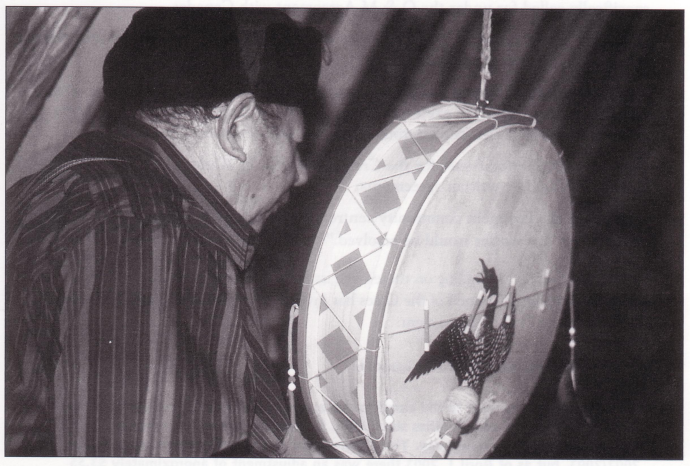
negotiation of the renewal of the Agreement is expected to commence under the auspices of the Dispute Resolution Panel presided over by Judge Rejean Paul.
E. Environmental Reviews of Cree Community Development Projects
While the Crees do not dispute the application of section 22 (Environment and Future Development Below the 55th Parallel) of the JBNQA, Cree community development projects have been reviewed and assessed under the said section. However, the adoption of amendments to the Canadian Environmental Assessment Act (CEAA) has resulted to a requirement for an additional review and assessment of Cree community development projects. Consequently, Cree bands have been denied access to federal funds for specific projects because of delays resulting from these CEAA provisions.
F. Cree Nation Governance
According to the Grand Council of the Crees (Eeyou Istchee), the Cree People determine their political development and
priorities. For the past three decades, the Grand Council of the Crees has acted as the Eeyou Tapaytahchehsou or Cree Nation
Government in its relations with Quebec and Canada. The next step for Eeyou governance is to expand the role of the Grand Council
in governing the Cree Nation in accordance with the will and aspirations of the Eeyouch of Eeyou Istchee. For these and other
reasons, the Crees must have stable relations with Canada through negotiations for an Agreement on Eeyou governance and other
related matters.
2. Whapmagoostui First Nation Chief David Masty of the Whapmagoostui First Nation, along with Mr. Andrew Kawapit, an elder and Mr. Elijah Sheshamush Jr., a youth, make a presentation7 to the Commission on February 10, 2004.
The representatives of the Whapmagoostui First Nation raised the following issues and concerns:
A. Whapmagoostui Council of Elders
In 1990, the Council of the Whapmagoostui First Nation established, by by-law, a local council of elders with advisory and administrative roles for the local government. The Council has concluded that there is a need to balance the traditional way and process of decision-making with the formal structure of local government and administration as established by and in accordance with terms and provisions of the Cree-Naskapi (of Quebec) Act.
B. Use of the Cree Language
The Council of the Whapmagoostui First Nation has expressed its position that the use of the Cree language as an official
language in governmental relations and administrative affairs should be recognized by all levels of governments.
C. Eeyou Self-Government
As far as the Whapmagoostui First Nation is concerned, the "Government of Canada must recognize and respect the government structures adopted by the Eeyou nations and provide support in a manner that advances the rapid transition of full self-government." 8
The Cree-Naskapi (of Quebec) Act must be amended to reflect and recognize the application of traditional law and practices and expand the powers of local government.
D. Department of Indian Affairs
The officials of the Department of Indian Affairs, responsible for the negotiation and implementation of agreements respecting Operations and Maintenance and Capital Projects, do not have the good will to respect Federal obligations and responsibilities to ensure that funding arising from these agreements meets the present and future needs, situation and concerns of the Eeyou local and regional governments.
The Government of Canada must fulfill its treaty obligations in a manner that sets out an acceptable standard of a Nation-to-Nation relationship between the Eeyou Nation and Canada.
E. Mandate of the Cree-Naskapi Commission
Chief David Masty states as follows:
- "The implementation of a treaty cannot be separate from the implementation of its enabling legislation. The mandate of the Cree-Naskapi Commission must explicitly include the implementation of the James Bay and Northern Quebec Agreement."9
- "Parliament must oblige the government to respond, in a comprehensive and timely manner, to the biennial reports and recommendations of the Cree-Naskapi Commission."10
F. Whapmagoostui Community Development Plan
In its 2000 Report and 2002 Report, the Commission acknowledges the difficult circumstances for the Whapmagoostui First Nation in planning the development and expansion of its community. In the 2002 Report, the Commission noted the commencement of the construction of a short gravel road giving access to the northeast area of the lands of the community. A review of the present community development plan of the Whapmagoostui First Nation must include the access and development of the south side of the river.
G. Implementation of the Cree-Naskapi (of Quebec) Act
Additional funds for the implementation of the Cree-Naskapi (of Quebec) Act are needed by the Cree communities and Cree local governments to meet their needs for training of staff for local administration and fiscal responsibilities.
H. General Assembly on the Cree-Naskapi (of Quebec) Act
The Whapmagoostui First Nation suggests that the Commission sponsor and organize a special general assembly of the Eeyou Nation for discussion on issues and concerns respecting the implementation of the Cree-Naskapi (of Quebec) Act. This special assembly of the Eeyou Nation should determine recommendations pertaining to appropriate amendments to the Cree-Naskapi (of Quebec) Act. The Department of Indian Affairs should provide funds to the Commission for this special general assembly of the Eeyou Nation.
3. Crees of the Waskaganish First Nation
Chief Robert Weistche of the Crees of the Waskaganish First Nation made a presentation11 to the Commission on February
10, 2004. Chief Weistche expressed the following concerns:
A. Electricity in Waskaganish
The Crees of the Waskaganish First Nation has raised the issue of electricity in the community in its 2002 brief; but the situation has not changed as the current electricity generation facilities remain inadequate and insufficient for the needs of the community. The Paix des Braves Agreement promises connection by Hydro-Quebec to its network within five (5) years of the signing of the said Agreement (which was signed on February 7, 2002).
In the meantime, the Government of Canada remains responsible for the provision of electricity for the community with adequate generation facilities and funding in order to meet the needs of the community.
The Crees of the Waskaganish First Nation request that the Commission "ensure that Waskaganish's needs and rights are recognized and addressed in the negotiations with both the Governments of Canada and Quebec with regard to the provision of electricity in the community."12
B. Housing
The Crees of the Waskaganish First Nation, in their 2002 brief, had explained the housing crisis in their community. The present housing situation, with mold-infested houses, serious structural problems and shortage of housing to meet the needs of an increasing population, remains a crisis. The current funding under the National Housing Act is inadequate to meet the current housing needs of Waskaganish. The Crees of Waskaganish has requested urgent assistance from the Government of Canada to replace over sixty-five (65) deteriorating housing units. Canada has not responded to this urgent request. Therefore, the Crees of the Waskaganish First Nation had to use funds derived from the Paix des Braves to replace some of these deteriorating units. However, housing remains a federal responsibility. Consequently, the Government of Canada must take the appropriate action in this housing issue.
The Crees of the Waskaganish First Nation asks the Commission "to intervene with the responsible federal authorities,
to ensure that adequate funding is provided to meet our current and future housing needs ... and to reimburse the Nation
for the funds expended by it."13
C. Community Infrastructure
Given the location of surrounding water bodies, location of the present airport and the poor soil conditions, Waskaganish is faced with serious barriers for community expansion that will require additional capital resources.
Waskaganish asks the Commission "to ensure that Canada becomes an active participant in the capital planning and funding of our community's growth, recognizing these special needs and the requirement that the community's infrastructure be expanded and modified to meet these unusual conditions."14
D. Economic Development
According to the Crees of the Waskaganish First Nation, the application of section 22(2) of the Cree-Naskapi (of Quebec) Act has resulted to limitations on the Band's economic development activities.
Section 22(2) of the Cree-Naskapi (of Quebec) Act states as follows:
"(2) A Band shall not engage, directly or indirectly, in any commercial activity, except in so far as it is related to
(a) the management or administration of
- i. its Category IA or IA-N land or the natural resources thereof, or
- ii. its buildings or other immovable assets on its Category IA or IA-N land, or
(b) the provision of public services to or in respect of its Category IA or IA-N land or residents thereof."15
The application and implication of this particular section of the Act should be reviewed.
Funding of economic development by Canada and Quebec has been minimal. The Crees of the Waskaganish First Nation has asked the Commission "to review the funding and programs currently offered to the Cree people to determine their adequacy within the context of the Cree-Naskapi (of Quebec) Act and the James Bay and Northern Quebec Agreement."16
4. Cree First Nation of Waswanipi
On February 11, 2004, Chief Robert Kitchen of the Cree First Nation of Waswanipi, assisted by Mr. Glen Cooper, made
a presentation17 to the Commission. Chief Kitchen raised the following issues and concerns:
A. Outstanding Issues
Chief Kitchen identifies the outstanding issues for negotiations and agreements as follows18:
1) Territorial integrity of Waswanipi lands
2) Original homeland and traditional government
3) Water rights and natural resources
4) Cree traplines and disputes
5) All claims and titles within Waswanipi ancestral territory
6) Restoration and protection of sacred areas, zones and sites
7) Recognition of Senneterre Crees (of Waswanipi)
8) Major clean-up operations and beautification throughout Waswanipi lands
9) Displacement and relocation of the original inhabitants of the "Old Post"
10) Special status, rights and powers of the Cree elders
B. Use and Occupation of Waswanipi Lands
The Waswanipi Eenouch call upon the Government of Canada to arrange a full-scale public inquiry on the use,
occupation and exploitation of Waswanipi lands and its natural resources. According to the Cree First Nation
of Waswanipi, Canada should be accountable and establish a Heritage Fund for the benefit of the present and
future generations of Waswanipi Eenouch.
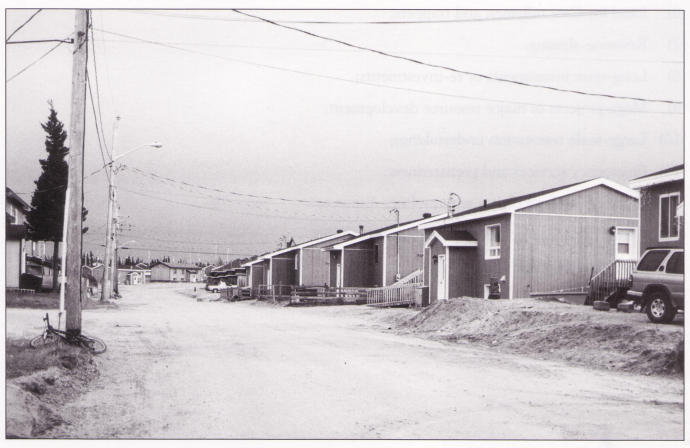
C. Relocation of the Waswanipi Eenouch and its Impacts
The Waswanipi Eenouch have been displaced and relocated as result of resource development within Waswanipi historical and traditional territories. The Cree First Nation of Waswanipi requests funding over a five-year period from Canada for research and development on impacts and remedial measures that would permit the proper development and maintenance of the social fabric of Eenou society.
D. Eeyou Sovereignty and Governance
The Waswanipi Eenouch consider themselves as a sovereign nation and a self-governing people since time immemorial. Therefore, as far as the Waswanipi Eenouch are concerned, the Government of Canada should recognize Eenou sovereignty, Nationhood and governance.
E. Backlog of Issues for Resolution
The Cree First Nation of Waswanipi wishes to enter into serious and meaningful negotiations with the Government of Canada to resolve the following backlog of issues19:
1) Shelter and infrastructure
2) Health care
3) Programs and services for the youth
4) Employment opportunities, businesses and economic initiatives
5) Local community justice system
6) Land for Cree tallymen and trappers
7) Revenue-sharing
8) Long-term investments or re-investments
9) Mega-projects or major resource development
10) Large-scale restoration undertakings
11) Emergency services and preparedness
12) Overlapping land claims and traplines disputes
13) Mini-Hydro electric development project study
14) Eeyou governance
F. Review of Provision of Programs and Services
The Waswanipi Eenouch are finding themselves behind in the provision of programs and services for the betterment of their standards of living. Therefore, in collaboration with the Grand Council of the Crees (Eeyou Istchee), they are prepared to enter into a process for the development of proper terms of reference for an independent review or inquiry.
5. Cree Nation of Washaw Sibi
The Washaw Sibi Eeyou are a group of about three hundred and fifty (350) Crees who are beneficiaries or eligible to be enrolled as beneficiaries of the James Bay and Northern Quebec Agreement. While they are part of the Cree Nation of Eeyou Istchee, the Washaw Sibi Eeyou have a distinct history, territory and vision.
The members of the Washaw Sibi Eeyou are presently residing in communities such as Pikogan, Lac Simon, Amos, Val d'Or, La Sarre, Matagami and in some Cree communities throughout Eeyou Istchee.
The mission of the Washaw Sibi Eeyou is to be recognized as members of the Cree Nation and to be fully integrated as beneficiaries of the James Bay and Northern Quebec Agreement and other related agreements.
To this end, the Washaw Sibi Eeyou are determined to attain status as a community of Eeyou and receive full benefits and exercise rights under the James Bay and Northern Quebec Agreement and related agreements.
In the Eeyou language, Washaw Sibi means 'river of the bay' in reference to the Harricana River which flows into James Bay. The Harricana River or Washaw Sibi is the fundamental link between the Washaw Sibi Eeyou and their traditional and historical territories which forms the southwestern sector of Eeyou Istchee. This homeland stretches from Hannah Bay southwest to the interior territories of the Abitibi region.
Chief Billy Katapatuk Sr. of the Cree Nation of Washaw Sibi made a presentation20 to Cree-Naskapi Commission, at its Special Implementation Hearings on February 12, 2004, in Montréal, Quebec.
Chief Katapatuk outlined the history of the Washaw Sibi in relation to their occupation and use of their traditional and historical territories and their past and current situation and circumstances.
While some members of the Washaw Sibi Eeyou are listed as beneficiaries of the James Bay and Northern Quebec Agreement, they do not receive the full range of benefits as the Eeyou of the other nine communities.
The Washaw Sibi Eeyou had been forced by the Department of Indian Affairs to relocate from their settlement on the outskirts
of La Sarre, Quebec to the Algonquin Reserve of Pikogan near Amos. This forced relocation has proven to be detrimental for
the social development of the
Washaw Sibi Eeyou who have encountered significant discrimination in the provision of programs and services.
The Washaw Sibi Eeyou also cannot fully maintain their cultural distinction and integrity in the context of
an Algonquin community.
Within this context, the Washaw Sibi Eeyou find themselves as being denied the full range of benefits and the exercise of rights (such as the inherent right of self-government) as contemplated in the James Bay and Northern Quebec Agreement.
The Grand Council of the Crees (Eeyou Istchee), at its 2003 Annual General Assembly of its members, adopted a members' resolution which formally recognizes and accepts the Washaw Sibi Eeyou as the tenth Cree First Nation. Consequently, the Washaw Sibi Eeyou participate in Eeyou governance or in the Eeyou Nation Government through representation on the Board/Council of the Grand Council of the Crees (Eeyou Istchee)/Cree Regional Authority.
The Washaw Sibi Eeyou acknowledge that an allocation of their own Category lands under the James Bay and Northern Quebec Agreement would be necessary for the provision of programs and services, development of their community and a territorial-base for the exercise of local government.
In their hope and desire to achieve their mission and vision, the Washaw Sibi Eeyou asks the Commission:
a) To be fully aware of the history and circumstances of the Washaw Sibi Eeyou;
b) To make the Government of Canada aware of its failure to fulfill its fiduciary obligations to the Washaw Sibi Eeyou and that the past federal actions seriously failed to protect the rights and interests of Washaw Sibi Eeyou;
c) To urge the Government of Canada to recognize the Washaw Sibi Eeyou as the tenth Cree First Nation and to undertake discussions and negotiations with the Washaw Sibi Eeyou on the establishment of the Washaw Sibi village within the framework of the James Bay and Northern Quebec Agreement.
6. Cree Nation of Mistissini
In the presentation21 of the Cree Nation of Mistissini dated February 23, 2004, Chief John Longchap raises the
following issues and concerns:
A. Past Presentations
Many of the issues and concerns raised by the Cree Nation of Mistissini in its past presentations to the
Commission remain outstanding and unresolved and "are adequately supported in the past reports of the Commission."22
The Cree Nation of Mistissini has serious concerns about the lack or absence of a comprehensive and adequate
response from Canada to the needs and concerns of the Nation.
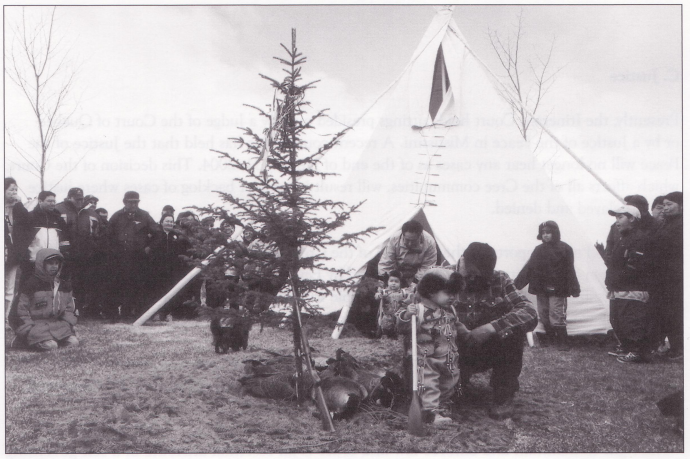
B. Cree-Naskapi (of Quebec) Act
The vision of the Cree Nation of Mistissini is that it be in full control of its own affairs as a self-determining and self-governing partner in Quebec society. The Nation contends that this is the real spirit and intent of the James Bay and Northern Quebec Agreement.
Consequently, the purpose of the Cree-Naskapi (of Quebec) Act is to provide the framework for an orderly and efficient system of Cree local government. However, "successive governments have failed to appropriate the necessary funds to fully implement the Cree-Naskapi (of Quebec) Act and have not fully respected their administrative and other obligations under the Cree-Naskapi (of Quebec) Act and the JBNQA."23
The Cree Nation of Mistissini finds some provisions of the Act as imposing "too much order, while others impede efficiency."24 Therefore, the Nation recognizes the need to amend the Cree-Naskapi (of Quebec) Act.
To this end, the Cree-Naskapi Commission should be mandated to conduct a full and comprehensive review of the terms and provisions of the Cree-Naskapi (of Quebec) Act and to recommend appropriate amendments to Parliament.
As reported in past presentations, some quorum provisions of the Act are too high and as such impede efficient decision-making
in governance. The Act should be amended to permit each Cree local government to determine and establish its own quorum
requirements or to establish processes other than voting at community meetings for decision-making on key issues.
C. Justice
Presently, the Itinerant Court holds sittings presided over by a Judge of the Court of Quebec or by a Justice of the Peace in Mistissini. A recent court ruling has held that the Justice of the Peace will no longer hear any cases as of the end of January 31, 2004. This decision of the Court, which affects all of the Cree communities, will result in a major backlog of cases where justice will be delayed and denied.
However and most important, the members of the Cree Nation of Mistissini need an alternative justice system that is determined and controlled by Eeyou. "A system of justice which reflects Cree values and language and which is accessible to the people because it is situated in the community would result in greater credibility and respect"25 by the members of the community.
In this regard, the proper implementation of section 18 (Administration of Justice-Crees) of the James Bay and Northern Quebec Agreement would commence the establishment of a framework for a Eeyou justice system in Eeyou Istchee.
"The right to maintain and enforce law and order is an essential attribute of a self-governing society."26
D. Police Matters
Given the current high incidences of offences and crimes and a rapid increase in the youth population, the community of Mistissini has an urgent need for more police officers. The current ratio of one police officer for every 1000 residents as contemplated in the James Bay and Northern Quebec Agreement is out-dated and inadequate for the present needs of a changing Eeyou society. Consequently, section 19 (Police-Crees) of the JBNQA must be amended accordingly.
E. Housing
Critical shortage of housing and related infrastructure remains the most serious issue and concern of the Cree Nation of Mistissini. Therefore, as an urgent priority for the Government of Canada, the Cree Nation of Mistissini recommends that the Department of Indian and Northern Development and Canada Mortgage and Housing Corporation develop and implement a strategic plan of action, in conjunction with the Cree Nation, to eliminate the increasing housing backlog in the Eeyou communities.
F. Partnership and Sharing of Resource Revenues
The Crees have yet to exercise their rights as to partnership in economic development such mining and forestry as
envisaged in the Agreement Concerning a New Relationship Between le Gouvernement du Quebec and the Crees of Quebec.
Furthermore, agreements between the Cree and governments and enabling legislation should ensure that revenue generated
from resource development in Eeyou Istchee is allocated as shared revenue for Eeyou local government.
G. Washaw Sibi Eeyou
The mission of the Washaw Sibi Eeyou to be recognized as members of the Cree Nation and to be full beneficiaries of the James Bay and Northern Quebec Agreement raises another concern of the Cree Nation of Mistissini.
The issues and concerns of the Washaw Sibi Eeyou must be discussed and resolved by the Grand Council of the Crees (Eeyou Istchee), the Government of Canada, the Government of Quebec and the Washaw Sibi Eeyou.
In particular, the Cree Nation of Mistissini recommends that the recommendation of the Commission in its 2002 Report be vigorously pursued to resolve this matter. The particular recommendation of the Commission is as follows:
- "18. The Government of Canada, Grand Council of the Crees (Eeyou Istchee) and the Crees of the Waskaganish First Nation should determine, with the participation of Washaw Sibi Eeyou, the feasibility and viability of the objective of the Washaw Sibi Eeyou to be recognized as full members of the Cree Nation of Eeyou Istchee and as full beneficiaries of the James Bay and Northern Quebec Agreement and other related Agreements. With respect to these matters, the participation of the Government of Quebec is required."27
H. Accountability and Indebtedness of the Bands
The Cree Nation of Mistissini is fully cognizant of the concerns of the Department of Indian Affairs and Northern Development in respect to the alleged indebtedness of the bands and the principle of accountability.
The Cree-Naskapi (of Quebec) Act establishes a legal and political regime for local Eeyou government which is accountable to the members of the Eeyou communities. As such, the local government is accountable to the Eeyou community on all matters respecting financial administration. The Cree Nation of Mistissini supports the principle of general accountability with the appropriate reporting mechanisms for financial accountability. However, by interpreting the requirement under the Act to submit a copy of the band's audit report to the Minister as an obligation of the Band to report to the Minister, the Department of Indian Affairs attempts to control the financial affairs of the Bands. This control of the said Department over the financial affairs of the Bands goes against the principle of accountability of Eeyou local governments to their members and residents as well as the right and principle of Eeyou self-government. The Cree Naskapi (of Quebec) Act should be amended to clarify political, administrative including financial accountability of Eeyou local government to the members of the Eeyou community.
Furthermore, in order to avoid a problem of indebtedness, the Government of Canada must ensure the ability of the Eeyou
local government to financially support its administration. Adequate financial resources for local government administration
are essential for the proper implementation of the Cree-Naskapi (of Quebec) Act.
I. Jurisdiction of the Cree-Naskapi Commission
According to the Cree Nation of Mistissini, the Government of Canada has ignored the recommendations of the Commission as the said government has taken the position that the Commission has no jurisdiction to report on the implementation of the James Bay and Northern Quebec Agreement. The present actions and position of Canada has made the Commission an ineffective mechanism for the resolution of Eeyou concerns and issues.
In the view of the Cree Nation of Mistissini, the Eeyou leadership "must seek to expand the mandate of the Commission so it can be more effective."28
7. Ouje-Bougoumou Cree Nation
Chief Sam Bosum made a presentation29 to the Cree- Naskapi Commission at its Special Implementation Hearings on February 23, 2004 in Montréal. Chief Bosum raised the following issues and concerns of the Ouje-Bougoumou Cree Nation:
A. Past Issues and Concerns
Chief Bosum stressed the fact that the issues and concerns of Ouje-Bougoumou are not new and have been presented to the Commission in the past briefs of the Ouje-Bougoumou Cree Nation. These concerns and issues have been raised in the reports of the Commission. However, the Government of Canada has not addressed them. The Ouje-Bougoumou Cree Nation hopes that the Cree Nation of Eeyou Istchee and the Government of Canada will develop and establish a new relationship-"a relationship in which legitimate concerns are not ignored, and a relationship in which there is serious intention to fulfill longstanding obligations and commitments."30
B. Ouje-Bougoumou/Canada Agreement
The Ouje-Bougoumou Cree Nation remains very concerned that there has not been a full implementation of the Ouje-Bougoumou/ Canada Agreement which was signed by the parties concerned in May, 1992.
Chief Sam Bosum reports that, to date, discussions with the representatives of Canada regarding their involvement in concluding a Complementary Agreement have been long and arduous with excessive delays caused by Canada. The Ouje-Bougoumou Cree Nations hopes that this will change so that the parties can quickly work toward the formal incorporation of Ouje-Bougoumou into the James Bay and Northern Quebec Agreement.
C. Operations and Maintenance (O & M) Funding
According to the Ouje-Bougoumou Cree Nation, the Government of Canada has an obligation to make O & M funding available to the Eeyou communities for its operating needs, but it has not acknowledged its responsibility in this matter. Consequently, Ouje-Bougoumou as well as the other communities, has faced and will continue to face difficulties in obtaining O & M funding for new facilities, needs and services.
The Ouje-Bougoumou Cree Nation once again recommends "a review of the O & M funding formula towards the end of incorporating
a financial capacity to address new needs not contemplated in 1984."31
D. Past Capital
Chief Sam Bosum once again raises the issue of past capital. According to the Ouje-Bougoumou Cree Nation, the Department of Indian Affairs and Northern Development (DIAND) has maintained and continues to maintain, in contradiction to clear and unambiguous obligations under the Ouje-Bougoumou/Canada Agreement, that they are not required to reimburse the Crees for the funding received by Ouje-Bougoumou for capital projects after 1994-1995. Since 1994-1995, the total value of capital funds transferred to Ouje-Bougoumou from the Cree Nation of Eeyou Istchee is $1.7 million. DIAND refuses to acknowledge that this amount as being owed to the Cree Nation.
E. Outstanding Claim
In addition, Chief Sam Bosum reminds the Commission "that there is a payment amount outstanding in relation to the funds transferred to Ouje-Bougoumou under the Ouje-Bougoumou/Canada Agreement which reflects the late payment of agreed amounts and loss of earnings associated with that amount. This remains an outstanding claim for an amount of $2,952,000."32
F. Relationship Between the Cree Nation of Eeyou Istchee and the Government of Canada
The Ouje-Bougoumou Cree Nation repeats its concerns about the overall relationship between the Cree Nation of Eeyou Istchee and Canada. Under the Agreement Concerning a New Relationship Between le Gouvernement du Quebec and the Crees of Quebec, the Cree Nation of Eeyou Istchee has entered into a new nation-to-nation relationship with Quebec in a manner that secures revenue-sharing, employment and contracting guarantees and a meaningful implementation of Quebec's obligations to the Crees for economic and community development in relation to certain provisions of the James Bay and Northern Quebec Agreement. The Ouje-Bougoumou Cree Nation reiterates its hopes that the Government of Canada will do likewise and adopt Quebec's approach in fulfilling its obligations to the Cree Nation in a way which addresses the spirit and intent of the JBNQA.
8. Cree Nation of Chisasibi
On February 10, 2004, representatives of the Cree Nation of Chisasibi addressed the Commission at its Special Implementation
Hearings. Chief Abraham Rupert with additional comments from Mr. Robbie Matthew, elder, and Ms. Ida Coonishish, youth, voiced
their concerns about the following matters:33
A. Block D
In its 2002 Report, the Commission had recommended that "Canada must exercise its responsibilities and ensure the proper
transfer of Block D lands for the exclusive use and benefit of the Cree Nation of Chisasibi."34
Mr. Michel Blondin, Director, James Bay Implementation Office, in his presentation to the Commission, on February 10, 2004,
states "that the department continues to support the Provincial government and the Chisasibi Council to effect this land
administration transfer; however, in doing so, it must ensure that the land transferred is environmentally sound."35
According to the department, "there are strong indications that a very small portion of the land which includes the landing strip, has been contaminated because of the site's industrial history and its current use as a landing strip."36 Consequently, all parties have agreed that an environmental study of the lands must be undertaken with subsequent decontamination of the site. The final report of the said study is due in November, 2004.
Because of the site's importance as a landing strip, Chief Rupert questioned the long delay in the transfer of Block D. Chief Rupert cannot accept this delay causing further delays in the establishment of proper facilities for the landing strip.
B. Dam Safety
The construction, operation and maintenance of massive hydroelectric dams along the Chisasibi River have caused and continue to cause grave concerns about the safety of the community and its residents.
C. Housing and Infrastructure
Chief Rupert considers the present housing situation with the backlog and shortage of houses in Chisasibi as a crisis. The community needs about four hundred (400) new houses for their immediate needs. The present housing crisis has caused many social problems. With its increasing population and presence of other residents from the institutions regarding health, social services and education, the present infrastructure of the community of Chisasibi is inadequate.
Ms. Ida Coonishish, youth from Chisasibi, confirms that young families are suffering from the backlog and shortage of housing in the community.
D. Radisson
As far as Chief Rupert is concerned, the James Bay and Northern Quebec Agreement provides that a permanent town was not to be established as a result of the construction and operation of the Complexe La Grande (1975). The present and continuing presence of the town of Radisson has contributed and continues to contribute to social problems (drugs, alcohol and gambling) of the community of Chisasibi.
E. Centrality of the Land
Mr. Robbie Matthew, elder, spoke about the centrality and connection of Eeyou Istchee to the traditions, culture and way of
life for Eeyou. He is concerned that Eeyou youth have lost their
connection to Eeyou Istchee. As one measure to restore this connection, Mr. Matthew spoke about a journey
to a gathering site by traditional means and the gathering of Eeyou from Chisasibi and Whapmagoostui.
F. Traditional Education
Mr. Matthew stresses the importance of living, learning and gaining an education out on Eeyou Istchee from peers and elders as traditional knowledge and the Eeyou traditional way of life cannot be taught and learned in a classroom environment.
G. Traditional Law
The elder from Chisasibi also spoke about the existence and application of traditional/customary law in the activities, lives and governance of Eeyou of Eeyou Istchee.
H. System and Quality of Education
Ms. Ida Coonishish, youth, expressed concern about the quality of education in the North as compared to the South. With a population of about 4000 residents, the number of graduates in Chisasibi is extremely low. She questioned the motives of teachers for their willingness to teach in the North.
Furthermore, the youth presently do not have adequate programs and services for accessing, learning and gaining an education in traditional knowledge and Eeyou traditional way of life.
I. Social Problems
The youth of Chisasibi face social problems such as alcohol and drug abuse, young parenthood and lack of housing that need immediate attention.
9. Cree Nation of Wemindji
On February 10, 2004, at the Special Implementation Hearings of the Commission, Mr. Mark Wadden, on behalf of the
Cree Nation of Wemindji raised the following concerns and issues:37
A. Past Issues
Mr. Mark Wadden states that the issues raised by the Cree Nation of Wemindji in its presentations of 2000 and 2002 remain the same and unresolved.
B. Firearms Legislation
It has been and remains difficult to implement the terms and provisions of the federal firearms legislation in Wemindji.
As an example, many people had applied for their certificates in conformity with the legislation: but have not received
their documents.
C. Election By-Law
The election by-law of the Cree Nation of Wemindji is presently under review by the community and should be tabled at the next local annual general assembly for approval and adoption by the members of the Cree Nation of Wemindji.
D. Incinerator
The Cree Nation of Wemindji has constructed, maintains and operates an incinerator for waste management as a pilot project. This project has attracted interest from the federal and provincial governments; particularly in regards to its environmental impacts. Therefore, the Cree Nation of Wemindji has applied for funding in respect to monitoring the impacts of this project. However, in this regard, Wemindji has not yet received any funding.
E. Access Road
The Department of Indian Affairs and Northern Development has said that the funding to be reimbursed to the Cree Nation of Wemindji for the access road project would be submitted to the Treasury Board; but as of February, 2004, the Cree Nation of Wemindji has not received a response.
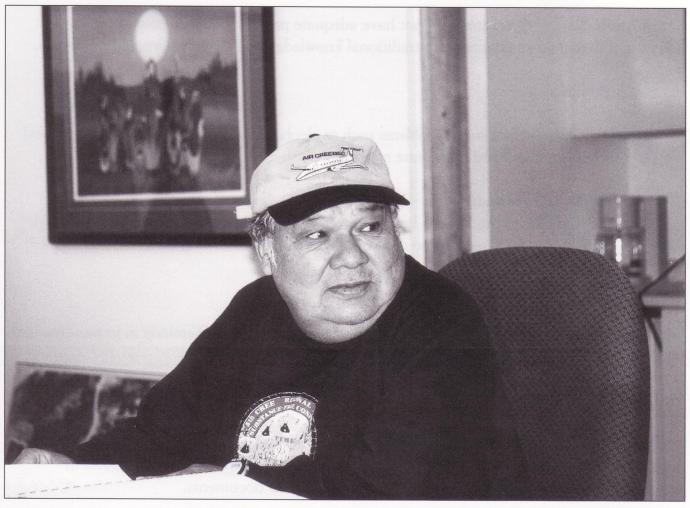
F. New Relationship with Canada
The Cree Nation of Wemindji strongly urges the Government of Canada to negotiate a new relationship agreement with the Cree Nation based on the implementation of the letter, spirit and intent of federal obligations to the Crees under the James Bay and Northern Quebec Agreement.
END NOTES
1 Grand Council of the Crees (Eeyou Istchee) Submission to the Cree-Naskapi Commission, Montréal, Quebec - February 12, 2004.
2 Letter addressed to Chief Billy Diamond and dated November 15, 1974 from Hon. Judd Buchanan, Minister of Indian
Affairs and Northern Development, p. 1.
3 Indian and Northern Affairs Canada Presentation to the Cree-Naskapi Commission - Presented at the Hearings of
the Cree-Naskapi Commission on February 10, 2004, p. 7.
4 Grand Council of the Crees (Eeyou Istchee) Submission to the Cree-Naskapi Commission, Montréal, Quebec - February 12, 2004, p. 4.
5 Ibid., p. 11
6 Ibid., p. 12
7 Cree-Naskapi Commission Special Implementation Hearings - Chief David Masty, Whapmagoostui First Nation.
8 Ibid., p. 2.
9 Ibid., p. 3.
10 Ibid., p. 3.
11 Brief Presented to the Cree-Naskapi Commission Special Implementation Hearings, Montréal, February 10, 2004 -
Presented by Chief Robert Weistche, Crees of the Waskaganish First Nation.
12 Ibid., p 2.
13 Ibid., p. 3.
14 Ibid., p. 3.
15 Cree-Naskapi (of Quebec) Act, section 22, sub-section (2).
16 Brief Presented to the Cree-Naskapi Commission Special Implementation Hearings, Montréal, February 10, 2004 -
Presented by Chief Robert Weistche, Crees of the Waskaganish First Nation, p. 4.
17 Cree-Naskapi Commission Special Implementation Hearings - February 11, 2004, Montréal, Quebec - Waswanipi,
Quebec, February 2, 2004.
18 Ibid., p. 2.
19 Ibid., pp. 4, 5.
20 Cree-Naskapi Commission Presentation by Chief Billy Katapatuk Sr., Cree Nation of Washaw Sibi, February 12, 2004.
21 Cree Nation of Mistissini's Presentation to the Cree-Naskapi Commission Hearings, February 23, 2004.
22 Ibid., p. 1.
23 Ibid., p. 1.
24 Ibid., p. 2.
25 Ibid., p. 3
26 Ibid., p. 3
27 2002 Report of the Cree-Naskapi Commission, p. 55.
28 Cree Nation of Mistissini's Presentation to the Cree-Naskapi Commission Hearings, February 23, 2004, p. 7.
29 Presentation by Ouje-Bougoumou at a Hearing of the Cree-Naskapi Commission, February 23, 2004, Montréal.
30 Ibid., p. 1.
31 Ibid., p. 3.
32 Ibid., p. 3.
33 Transcripts of the Cree-Naskapi Special Implementation Hearings, Community of Chisasibi - Chief Abraham Rupert,
February 10, 2004, Montréal, Quebec.
34 Report of the Cree-Naskapi Commission 2002, p. 54.
35 Indian and Northern Affairs Canada Presentation to the Cree-Naskapi Commission, February 10, 2004, pp. 9, 10
36 Ibid., p. 10
37 Transcripts of the Cree-Naskapi Special Implementation Hearings, Community of Wemindji - Mark Wadden, February
10, 2004, Montréal, Quebec.

Naskapi Eeyouch (Nation) of Kawawachikamach
TThis Chapter on the Naskapi Eeyouch (Nation) of Kawawachikamach must be read
in conjunction with Chapter 5 respecting the responses of Indian and Northern Affairs Canada to the 2002
Report of the Cree-Naskapi Commission as outlined in the said Department's presentation to the Commission on February 10, 2004.
On February 12, 2004, the Chief Elijah Einish and representatives of the Naskapi Eeyouch of Kawawachikamach made a presentation to the Cree-Naskapi Commission at its Special Implementation Hearings in Montréal (Quebec).
In their presentations, Chief Einish and Mr. John Mameamskum, Director General, of the administration for the
Naskapi Nation of Kawawachikamach raised the following principal matters:
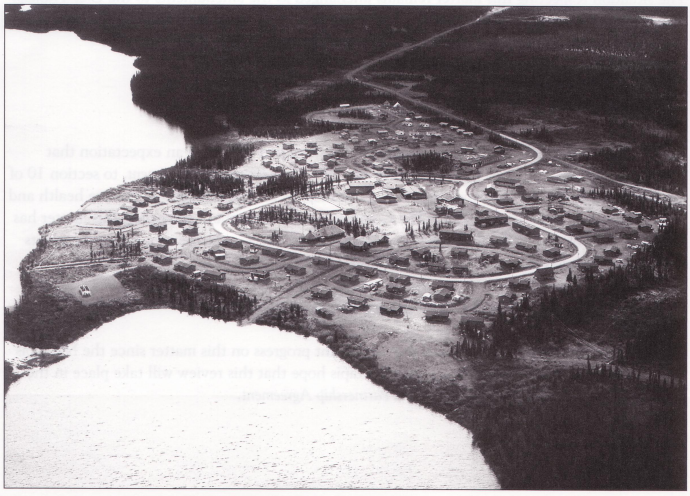
1. Governance
A. Amendments to the Cree-Naskapi (of Quebec) Act
The Naskapi Eeyouch expressed, as mentioned in their previous briefs, a preference to reach agreement with the Crees on amendments to the Cree-Naskapi (of Quebec) Act and thereafter make joint proposals to the Minister of Indian Affairs and Northern Development.
The amendments as desired by the Naskapi Eeyouch include the following:
a) "lowering certain quorums;
b) permitting law enforcement officers to issue tickets rather than summonses under the Criminal Code to offenders against Naskapi Nation by-laws; and
c) an amendment to permit Council to conduct business without calling a meeting in certain circumstances."2
B. Amendments to the Cree-Naskapi (of Quebec) Act under Bill C-23
The situation respecting this matter remains unchanged as the amendments to the Cree-Naskapi (of Quebec) Act has not come into force due to the lack of an agreement between Canada, the Crees and the Naskapi on the regulations defining "consorts" under Bill C-23-The Modernization of Benefits and Obligations Act.
C. Review of Section 10 of the Northeastern Quebec Agreement
In its 2002 presentation to the Commission, the Naskapi had expressed an expectation that Canada would consent to an amendment, by way of a Complementary Agreement, to section 10 of the Northeastern Quebec Agreement respecting eligibility of certain Naskapis to receive health and social services at the Naskapi CLSC. The Complementary Agreement respecting this matter has been executed by the Naskapi Landholding Corporation. The Complementary Agreement awaits signature by representatives of Quebec and Canada.
D. Review of Section 11 of the Northeastern Quebec Agreement
The parties concerned have not made any significant progress on this matter since the Naskapis' 2002 submission to the Commission. The Naskapis hope that this review will take place in the context of negotiations with Quebec for a Partnership Agreement.
E. Nunavik Commission
In March 2001, the Nunavik Commission produced its Report that sets out its recommendations for the negotiations and creation of a Nunavik Government. The subsequent negotiations between the Inuit of Quebec, the Government of Canada and the Government of Quebec has led to a Framework Agreement in 2003. As far as the Naskapis are concerned, "nothing substantive has been done by Canada or any other party to respond to the fundamental and legitimate concerns by the Nation over the last sixteen (16) years."3
The Naskapis want to know what the Commission has done to intervene on their behalf in respect to their rights and concerns. In response to this request, the Commission has informed the Naskapi Nation, by letter addressed to Chief Elijah Einish and dated March 22, 2004, on the measures undertaken by the Commission to intervene on the behalf of the Naskapi Nation in respect to their rights and interests.
Nevertheless, the Naskapi Nation requests the Commission "to intervene forcefully and publicly in support of our rights and interests."4
2. Policing
The Naskapi Nation has not had a tripartite policing agreement since April, 2000, because of a continuing cost-sharing
dispute between Quebec and Canada. As of January 25, 2004, Canada and Quebec have assured the Naskapis that they were
ready to sign a tripartite policing agreement.
3. Community
A. Electricity Supply
In its 2002 Report, the Commission had recommended that "the Department of Indian Affairs and Northern Development ... exercise its responsibilities for the provision of electricity to Kawawachikamach."5
The Naskapi Nation notes the lack of support from the Department and the Commission in respect to this matter.
In response, the Commission has informed the Naskapi Nation, by letter addressed to Chief Elijah Einish and dated March 22, 2004, on the measures undertaken by the Commission to intervene on the behalf of the Naskapi Nation in respect to this issue.
The Naskapi Nation of Kawawachikamach states that Quebec has mandated Hydro-Quebec to act on behalf of the government.
Hydro-Quebec may become the owner of the transmission and distribution infrastructure located in Quebec and may give
a contract to a Naskapi/Innu corporation for its operations and maintenance. Furthermore, an Agreement in Principle
has been signed with Newfoundland and Labrador Hydro, whereby a native-owned corporation would lease and upgrade the
powerhouse and the transmission infrastructure located in Labrador.
B. Housing
The decline in funding from the Canada Mortgage and Housing Corporation for new housing construction and the growing backlog of housing has compounded the housing situation in Kawawachikamach.
The Naskapis want to know if the Commission has "intervened with the responsible federal authorities to ensure that adequate funding is provided to the Nation's housing needs."6 In response to this request, the Commission has informed the Naskapi Nation, by letter addressed to Chief Elijah Einish and dated March 22, 2004, on the measures undertaken by the Commission to intervene with the responsible federal authorities.
C. Loss of Traditional Way of Life
Mr. Philip Einish, Jr., elder of Kawawachikamach, expressed concern about the loss of Eeyou culture, language and the traditional way of life.
4. Supplementary Comments
Chief Elijah Einish and other representatives of the Naskapi Nation of Kawawachikamach presented an additional brief 7
which outlines their supplementary comments in relation to the presentation by the Department of Indian Affairs and Northern
Development to the Cree-Naskapi Commission on February 10, 2004. The said brief comments on the following matters:
A. Negotiation Process Regarding the Establishment of Nunavik Government
The Naskapi Nation takes issue with Canada's presentation. The Naskapis are offended by Canada's usage of the term "Nunavik" which means "our land" in Inuktitut. The term is used to include lands north of 55th parallel and includes the historical and traditional territory of the Naskapi Nation. The Government of Canada clearly, according to the Naskapis, has failed "to discharge its responsibility to ensure that our Aboriginal and treaty rights are respected."8
Contrary to the presentation of Canada to the Commission, the Naskapis do not believe that any progress has been on this matter.
The Naskapis interpret "Canada's suggestion for a low-level working group involving Canada, Quebec, the Inuit and
ourselves to be a totally inadequate response to our legitimate demands."9
B. Housing
The Naskapis disagree with the position of Canada as expressed in its presentation that additional funding will not resolve housing problems in Cree and Naskapi communities.
The Naskapis consider themselves to be leaders in the design and construction of houses that exceed applicable norms. Consequently, the life spans of almost two-thirds of the housing in Kawawachikamach are already over twenty (20) years old. The suggestion of Canada that the national average of twenty (20) years for the life of house applies to Kawawachikamach is inaccurate.
Furthermore, given the high levels of unemployment in the Schefferville area, "there is no reason to believe that greater effort to encourage a private housing market would have anything more than a trivial impact on the need for housing."10
The Naskapi Nation considers additional funds as the only one solution to the housing crisis in Kawawachikamach.
END NOTES
1 Brief Presented to the Cree-Naskapi Commission Special Implementation Hearings, Montréal, 12 February, 2004 - By Naskapi Nation of Kawawachikamach
2 Ibid., p. 6.
3 Ibid., p. 7.
4 Ibid., p. 7.
5 The 2002 Report of the Cree-Naskapi Commission, p. 52.
6 Brief Presented to the Cree-Naskapi Commission Special Implementation Hearings, Montréal, 12 February, 2004 - By Naskapi Nation of Kawawachikamach. p. 10
7 Brief Presented to the Cree-Naskapi Commission Special Implementation Hearings, Montréal, 12 February, 2004 - Supplementary Comments - By Naskapi Nation of Kawawachikamach
8 Ibid., p. 1
9 Ibid., p. 1
10 Ibid., p. 2

Response of the Department of Indian Affairs and Northern Development
BACKGROUND
In preparation for every biennial report since its first one in 1986, the Cree-Naskapi Commission has conducted
comprehensive public hearings at which each Cree and Naskapi First Nation as well as other interested parties have
had an opportunity to present issues and concerns of importance to them. Presenters have, as a general rule, considered
that the matters which they brought to the attention of the Commission were serious and that, other effective means
of redress were generally not readily available to them. The Commission has taken the view that presentations made
at its hearings deserve to be treated respectfully and given serious consideration. A large majority of the matters
raised at the hearings are, after some research and analysis, included in the biennial reports. Everyone involved
knows that the reports are submitted to the Minister and then tabled in both Houses of Parliament. It has been our
experience that, for this reason, people raise only serious matters, prepare their presentations with commendable
diligence and expect that their issues will be addressed in an appropriate manner.
Over the years, while there have been a wide variety of specific issues raised, there have also been a number of consistent themes especially on the broader issues. These themes have included, for example:
a. the need for better mechanisms and processes to implement the James Bay Northern Quebec Agreement and the Northeastern Quebec Agreement,
b. a more effective process for the timely determination and delivery of operations and maintenance funding,
c. the critical need for adequate resources for housing,
d. the need for increased support for economic and community development,
e. the desirability of having effective dispute resolution structures and processes,
f. the importance and recognition of the role of traditional and customary law,
g. the need for amendments to bring the Cree-Naskapi (of Quebec) Act up to date based on the governance experience of the Cree and Naskapi governments over the past twenty (20) years.
It is not surprising that in most cases the issues brought to the attention of the Commission are not intended to
be messages of congratulation for the Department of Indian Affairs or for the Cree and Naskapi governments (or indeed
for the Commission itself). Over the years many individuals, First Nations and indeed the Government of Canada have
laid before the
Commission what can only be called "complaints." It follows then that a significant number of the findings and recommendations of the Commission flow from these "complaints." It has always been the hope of the Commission that recommendations will be taken as suggestions for improvement and not merely as criticism. Few people enjoy being criticized and often react by lashing out or trying to ignore the issues.
Responses of the Department, 1986 to 2002
The responses of the Department of Indian Affairs and Northern Development to the reports of the Commission have
evolved over the years. From the first report 1986 until 1998 the Department simply ignored the findings and
recommendations contained in the reports although departmental officials often objected that the Commission was
"fed-bashing" or biased in favour of the Cree and Naskapi. (Ministers, it should be noted, did not join their
officials in these types of reactions.) In any case, for sixteen (16) years there was never any response to the
substantive matters addressed in the reports.
This lack of response seemed somewhat difficult to understand in the context of what the duty to report entails and how that duty came to be a requirement under the legislation. Lengthy and complex negotiations had led to the signing in 1975 of the James Bay and Northern Quebec Agreement and a short time later the Northeastern Quebec Agreement, the first modern-day treaties in Canada. These documents subsequently became entrenched in the Constitution by virtue of the 1982 amendments. The Agreements provided, among other things, for the enactment of legislation to replace the Indian Act insofar as it applied the Cree and Naskapi Nations. After further complex negotiations, the Cree-Naskapi (of Quebec) Act was passed. That Act in Part XII created the Cree-Naskapi Commission, one of whose duties was to prepare a report every other year on the implementation of the Act. In preparing this report, the Commission holds public hearings for which the Cree and Naskapi Nations, the Department and others prepare detailed presentations of their issues and concerns. The report is then required to be submitted to the Minister and to be tabled in the House of Commons and the Senate. The House of Commons, by Standing Order, then refers the report to its Standing Committee for detailed review. That the Department of Indian Affairs and Northern Development, which has responsibility for the Cree-Naskapi (of Quebec) Act, chose to simply ignore reports prepared in this context certainly raised some serious concerns.
After a decade of seeing little or no impact or follow up to their presentations at Commission hearings, some of the communities began to question whether there was any point in researching, preparing and presenting detailed presentations at the Commission's hearings. The Cree and Naskapi leadership called repeatedly for departmental responses to the reports. In one example, the Grand Council of the Crees (Eeyou Istchee) joined with the Commissioners in meeting with the Minister and called for a formal response. The Minister made a commitment to respond within a short time but no response was made.
Following the 1998 Report as well as the failure of officials to carry out the Minister's commitment noted
above, the Commissioners decided that it was necessary to become much more proactive in following up on its
recommendations. The Commissioners believed that their legislated duty to report to the Minister as well as
to Parliament necessarily implied a concomitant duty on the part of Government to address the recommendations
contained in the reports. We also believed
that basic respect for those appearing at Commission hearings required that their concerns and issues be
taken seriously. With these considerations in mind, the Commission undertook several major initiatives to
elicit a government response. Specifically these included:
a. follow up with the Minister and departmental officials,
b. follow up with the Cree and Naskapi governments,
c. appearances before the Parliamentary Committees and meetings with individual MPs and Senators,
d. follow up with interested third parties, and
e. preparation and distribution of Discussion Papers on the more complex recommendations.
After the 1998 Report, it took two years for the Department of Indian Affairs and Northern Development to respond, but on February 11, 2000 (during the course of the Special Implementation Hearings for the 2000 Report) the Department did react.
The responses given were oral and, unfortunately, non-specific in the case of twelve (12) of the recommendations. The Department side stepped a further twenty-nine (29) recommendations by saying either that they "were not directly related" or "not necessarily related" to the implementation of the Act.
As a result of the failure of the Department to deal substantively with most of the recommendations contained in the 1998 Report, the Commissioners decided to pursue more proactive follow up processes with the recommendations in the 2000 Report. The most effective of these processes was to seek the assistance of the House of Commons Standing Committee on Aboriginal Affairs, Northern Development and Natural Resources to have the issues raised by the Cree and Naskapi nations, and addressed in our recommendations, dealt with by the Department. In fact the Standing Committee conducted a full hearing of the issue and, after considering options, wrote to the Minister requesting a timely response to the recommendations. Finally, in January of 2002, a written response was sent to the Chair of the Committee (more than t wo (2) years after the Minister had first promised to respond).
While it was an improvement over the previous practice of no written response at all, the Department's letter was something of a disappointment. Of the thirty-four (34) recommendations made, the answer to nineteen (19) of them was simply to say that they were "considered beyond the explicit legislated mandate of the Commission. " Several others were effectively ignored by claiming that they did not involve "a formal expression of interest" by the Cree and/ or the Naskapi.
Response of the Department to the 2002 Report of the Commission
The Department's response to the 2002 Report marked a new and entirely different approach. The Director of the
James Bay and Northern Quebec Implementation Office appeared at the Special Implementation Hearing held on
February 10, 2004 and provided specific responses
to each of the twenty (20) recommendations contained in the 2002 Report. There were no comments that any recommendations were "not necessarily related" to implementation or "considered beyond the explicit legislated mandate of the Commission."
That all of this represented a changed approach to dealing with the Commission as well as the communities was explicitly recognized. The Director, speaking for the Department, said: "We want to enhance the relationship between INAC, the CNC, the Cree and Naskapi." Later he added: "And so we hope you recognize that as much as we would like it to be otherwise, the path of change in a bureaucracy is seldom straight and constant." He then proceeded to provide specific responses to each of the recommendations contained in the 2002 Report of the Cree-Naskapi Commission.
As noted in our last Report, the Commissioners believe that people are their own best spokespersons. With that in mind, the full edited text of the responses of the Department of Indian Affairs and Northern Development to the recommendations contained in the 2002 Report is as follows:
Edited Text of the Departmental Response
1. Relationship between Canada and the Cree Nation
Recommendations 1, 12, 13 and 19 of the 2002 CNC Report represent together a concern about the relationship between the Cree Nation and the Government of Canada. Indian and Northern Affairs Canada (INAC) considers that the CNC believes "that we all must:
a) Acknowledge the need to redefine Cree self-government
b) Undertake this redefinition process, and forge a new relationship more like that in the New Relationship with Quebec
c) In the process of redefinition or after the redefinition is complete, review the Act and revise if and as required
d) Clarify the mandate of the CNC, address issues unresolved from previous years
e) Ensure that the inclusive processes are used and that adequate funding is allocated to all of these tasks."1
Mr. Michel Blondin, representative of INAC, responded as follows:
- "We agree that these are the goals we should be working towards, and we have put
considerable effort into making this happen. Following the proposal from Grand Chief
Moses of June 2002, and the additional details provided by Cree representatives in
January 2003, Federal and Cree negotiation teams met ten times during 2003 to
discuss the Cree proposals ... I will say that the Crees have proposed that Canada
make sweeping changes to many areas covered by the JBNQA.
- As a result, we have submitted our recommendations to our Minister for a federal negotiation mandate with the Cree. Once we get the negotiation mandate we seek, we will work with the Cree to develop a negotiation process that acknowledges and respects the degree to which all of the recommendations with which I started this discussion are inter-related."2
2. Ouje-Bougoumou Incorporation and Land Transfer
Recommendations 2 and 11 of the 2002 CNC Report addressed these issues. The representative of INAC stated as follows:
- "There has been considerable work done on this issue. Since December 2002 I have
participated in a tripartite working group, comprising representatives of the Ouje-Bougoumou
and Mistissini Cree Nations, the Quebec government, and Canada has been meeting regularly ...
- There are two challenges confronting this group: How to handle the land transfer, on one hand; and the contents of the Complementary Agreement, on the other hand ...
- The land transfer presents a challenge as the voters in the two referenda held in Mistissini over the years-the latest in January 2003-did not support the proposal to effect the land transfer. Mistissini representatives have expressed the difficulties with having another vote. We have been consulting with Justice Canada over the last few months to find a way to resolve this issue and I am confident we are close to a solution that will be satisfactory to all parties ...
- The second issue is more difficult. In the complementary agreement Canada did not expect to go into as much details as has been proposed by the Cree. As this issue is also the object of Cree litigation, which has been recently amended and expanded, the addition of many details in the draft complementary agreement is problematic. However, there is goodwill on all sides and I am confident we can overcome our differences ...
- Work on an amendment to the Cree-Naskapi (of Quebec) Act should follow shortly, unless the parties agree that it should wait for other major amendments to that legislation."3
- There are two challenges confronting this group: How to handle the land transfer, on one hand; and the contents of the Complementary Agreement, on the other hand ...
3. Negotiation Process Regarding the Establishment of Nunavik Government
In its 2002 report, the CNC had recommended that "INAC and the Naskapi Nation should review the present process of negotiations respecting the possible establishment of a Nunavik government and determine how the rights and interests of the Naskapi can be best protected."
INAC responded that the members of the Tri-Partite Commission for the Establishment of a Nunavik Government visited Kawawachikamach and "assured the Naskapi people that their rights would not be compromised."4
In addition, "Canada took the initiative to organize a meeting between the Naskapi, the Inuit, Quebec, and
Canada in Québec City on February 7, 2003 ... No specific decisions were made at that meeting. Upon reflecting
on the outcome of that meeting, the Naskapi representatives sent a letter to all involved parties stating that
their concerns were not yet resolved ...
 As a result, a meeting was held between the Naskapi and Canada on January 14, 2004 to discuss the establishment
of a working group that would include Canada, Quebec, the Inuit and the Naskapi. The newly-elected Naskapi Chief
will discuss this matter at the next Naskapi council meeting. We are awaiting their decision and remain ready and
committed to participating in the process."5
As a result, a meeting was held between the Naskapi and Canada on January 14, 2004 to discuss the establishment
of a working group that would include Canada, Quebec, the Inuit and the Naskapi. The newly-elected Naskapi Chief
will discuss this matter at the next Naskapi council meeting. We are awaiting their decision and remain ready and
committed to participating in the process."5
4. Naskapi Policing Services
Recommendation 4 of the 2000 Report of the CNC reads as follows:
"INAC and the Naskapi Nation review the funding arrangement for policing services for Kawawachikamach and determine a possible solution for the current cost-sharing dispute. The Commission recognizes the required participation of Quebec in this process."
The representative of INAC stated as follows:
"It is my understanding that this issue is now resolved. Previously, policing services were provided under two bilateral agreements: one between the Naskapi Nation and the Quebec government, and another between the Naskapi and the Department of the Solicitor General of Canada. For the future, negotiations have been undertaken to instead forge a tripartite agreement, in which Canada will provide 52 percent of the funding for policing services and Quebec will provide 48 percent. I understand that these negotiations are going well and that the new tripartite agreement will be signed very soon. We will keep in contact with the representatives of the Solicitor General of Canada to monitor this and other policing arrangements with the Cree and the Inuit."6
5. Naskapi Electricity Supply
In recommendation 5 of its 2002 report, the CNC stated that "INAC must exercise its responsibilities for the provision of electricity to Kawawachikamach."
The representative of the department responded as follows:
- "We believe that the resolution of this issue requires complex negotiations between Canada, the Naskapi and
Quebec. It is not an issue on which I was able to spend enough time and hopefully this can be corrected in the near future."7
6. Housing
The CNC had recommended the provision of adequate funding for present and future housing needs of the Naskapi Nation as well as a review of the housing needs of the Cree Nation with appropriate measures to meet the present and future housing needs of the Cree people. (Recommendations 6 and 8 of the 2002 CNC Report)
INAC responded as follows:
"The lack of adequate housing is indeed a serious issue in most Cree and Naskapi communities, as it is in most Northern Indian communities across the country. The impacts of the housing situation are profound and far-reaching. However, there is an additional complication in the case of the Cree in that they have often asserted a special right to housing under the JBNQA. Canada disagrees, but I will ensure that they have access to the federal housing programs in the same manner as the other Indians on reserves across Canada. Having said that, I do not believe that additional funding, whether the Cree have a special right to it or not, will resolve housing problems in Cree and Naskapi communities. The department would like to see a more concerted effort to address housing in a more comprehensive manner, including:
a) more efforts to plan communities and their housing in an appropriate manner, especially given the northern context. The research division of the Canada Mortgage and Housing Corporation has developed some remarkable material on that subject;
b) more efforts to limit access to social housing to only those families who need it, and more support to a private housing market for people with more financial means. This should include non-financial initiatives such as providing the legal framework for individuals who can afford it to have access to mortgages;
c) continue community efforts to leverage as much economic development as possible out of infrastructure and housing construction.
Taken together, these measures, and others as required, should aim to extend the life of houses from a current average of under twenty (20) years to an average house life of above fifty (50) years. This is the key. Without it there is not much chance to resolve the housing crisis.
It is in this context that the department intends to address the issue of housing with the Cree and Naskapi communities, as a priority, in 2004."8
7. Revision of O & M Funding Formula
The CNC had recommended "a review of the O & M funding formula by the federal and Cree parties
with a view of incorporating a financial capacity to address new needs not contemplated in 1984." (Recommendation 7 of the
2002 CNC Report.)
INAC agreed "that the review you have recommended is appropriate.This will take place in the next few months as part of the renegotiation of the 1995 O & M Agreement. However, Canada considers it essential that at the same time we look into a financial capacity to address new needs not contemplated in 1984. The parties should also review what the current funding is used for. Finally, Canada will also want to review the First Nations' capacity to generate its own revenues, as was done in the 1980s when the original grants were negotiated.
The renewal of the 1995 O & M Agreement has been delayed for a variety of reasons by one party or the other during the last few years. However, I believe the parties are now ready to proceed with this negotiation and it is my hope that we can conclude it in 2004."9
8. Ministerial Housing Guarantees
The CNC had recommended that "INAC should negotiate in good faith with the Crees of Waskaganish to settle the dispute over the Ministerial guarantees for housing projects." (Recommendation 9 of the 2002 CNC Report.)
The representative of INAC considered this issue resolved but undertook to raise this matter with Chief Weistche "to ensure there is no residual problem."10
9. Provision of Electricity to Waskaganish
The Commission recommended that INAC "meet its responsibilities and obligations and ensure the provision of electricity in a manner that the meets the needs of the Crees of the Waskaganish First Nation." (Recommendation 10 of the 2002 Report of the CNC.)
The department responded as follows:
- "The history of this issue is long and complex. INAC has produced and distributed
electricity to the community of Waskaganish for more than thirty (30) years. During
that time, there have been numerous attempts to transfer responsibility for hydro
electric power for the community to Hydro-Quebec.
- In 2002, as part of the New Relationship Agreement with Quebec, Hydro-Quebec committed to building the transmission line to Waskaganish by December 2006 at the latest, without any financial involvement from Canada. We expect the line to come in as committed. I wish to reassure the community of Waskaganish and the Commission that Canada will cooperate with the Waskaganish Council and Hydro- Quebec to ensure that the local distribution network is ready to be connected to the transmission line and will take care of the removal of the generating equipment, including any cleanup needed, as was done in other Cree communities. Again, I will raise this issue with Chief Weistche at the first opportunity to reassure him on this subject."11
10. Transfer of Block D Lands to the Cree Nation of Chisasibi
Recommendation 14 of the 2002 Report of the CNC stated that "Canada must exercise its responsibilities and ensure
the proper transfer of Block D lands for the exclusive use and benefit of the Cree Nation of Chisasibi."
INAC responded as follows:
- "I want to assure the Commission that the department continues to support the
provincial government and the Chisasibi Council to effect this land administration
transfer. However, in doing so it must ensure that the land transferred is
environmentally sound ... There are strong indications that a very small portion
of the land, which includes the landing strip, has been contaminated because of
the site's industrial history and its current use as a landing strip. This small piece
of land has come to be referred to as the 'red rectangle.'
- All parties involved have agreed that an environmental study of the lands must be undertaken. The terms of reference for that study have already been developed by Quebec, who will let the contract. We are told that the contract will be awarded and that work on the environmental study should start in late April. An interim report is scheduled for the end of June 2004, and the final report is due in November 2004.
- All parties have agreed that if the interim report, due at the end of June, shows relatively low levels of contamination ... Canada would then immediately initiate a survey of Block D lands. Once that survey is done, provincial officials would initiate the Order in Council through which the full land transfer will be effected.
- All parties have also agreed that if the preliminary report shows contamination within the red rectangle, but relatively low levels of contamination outside it, then the same steps would be taken to instead effect a partial transfer that would include all lands except the red rectangle. Then, once the red rectangle is decontaminated, which will probably take a number of years, a survey would be undertaken and an Order in Council prepared to transfer that piece of land, and thus complete the full transfer of Block D lands to the Chisasibi Nation.
- It is regrettable that this land transfer cannot proceed any faster. However, we will continue to participate actively in the meetings on this issue to ensure that delays are kept to the minimum necessary."12
- All parties involved have agreed that an environmental study of the lands must be undertaken. The terms of reference for that study have already been developed by Quebec, who will let the contract. We are told that the contract will be awarded and that work on the environmental study should start in late April. An interim report is scheduled for the end of June 2004, and the final report is due in November 2004.
11. Training Needs
As the Cree governments are continuously facing new needs and demands in administrative responsibilities, Recommendation 15 of the 2002 Report of the Commission stated that the "government of Canada must respond to these needs by expanding and creating new training programs and opportunities."
INAC responded by stating:
- "We agree that effective self-government demands that service providers be
well-trained. In 2001, the Cree Regional Authority, Human Resources Development
Canada and my department, entered into a five-year agreement to provide for
human resources development in the territory. I understand that it took a while for
the necessary structures and personnel to be put in place by the CRA, but I would expect
that by now it is capable of assisting the Cree regional and local governments with their
training needs. In any case, I will ask the departmental officer responsible
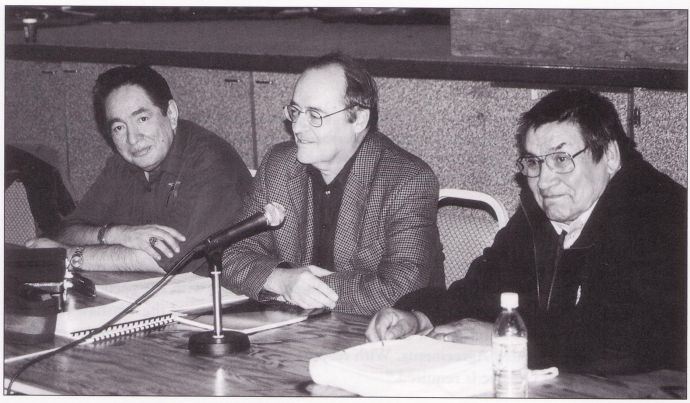
- for this agreement to review the issue with the HRDC and Cree representatives as soon as is feasible. In addition, I intend to follow up with the regional and local governments on this issue during the O & M Agreement renegotiation."13
12. Whapmagoostui Town Plan and Community Expansion
In its Recommendation 16 , the CNC recommended that "INAC and the Whapmagoostui Nation should review the community plan and determine funding for the expansion of the community in accordance with the aspirations of the Eeyouch of Whapmagoostui."
The department responded:
- "This was discussed during a meeting between departmental and CRA representatives in November 2003 ... . During our November meeting, both parties agreed that expansion in Whapmagoostui will be very challenging because the soil is so rocky. That complicates engineering ventures and increases expenses related to community expansion. Recognizing that an on-site inspection will be helpful in getting a handle on what needs to be done and how expensive it will be, both parties agreed that arrangements should be made for representatives from the department to visit Whapmagoostui within the next few months. During this visit we will also seek to establish an action plan with the Whapmagoostui Chief and Council to deal with the issue for the long term."14
13. Timely Administration of Justice
The 17th recommendation of the 2002 CNC report stated as follows:
"As the administration of justice is clearly a function and concern of local government, the Commission recommends
that the Judicial Advisory Committee contemplated by paragraph 18.0.37 of section 18 of the JBNQA address the need
for a timely administration of thejudicial process for the Cree communities. While the administration of justice in
this case is considered a provincial matter, Canada must ensure that treaty and constitutional rights of the Cree are
respected in this process."
INAC responded:
- "Canada has recently become aware that Cree representatives are discussing Justice matters bilaterally with Quebec and has approached the provincial government to be part of these discussions. Also, this may become a subject of negotiation between the Cree and Canada if negotiations for a global agreement start in 2004."15
14. Recognition of Washaw Sibi Eeyou
In recommendation 18, the CNC recommended that "Canada, the Grand Council of the Cree and the Cree of the Waskaganish First Nation should determine, with the participation of the Washaw Sibi Eeyou, the feasibility and viability of the objective of the Washaw Sibi Eeyou to be recognized as full members of the Cree Nation and as full beneficiaries of the JBNQA and other related Agreements. With respect to these matters, the participation of the Government of Quebec is required."
The department responded:
- "A number of meetings between the department and the WSE representatives were
held during 2003. These included meetings between senior officials from both
groups and meetings of more technical people from both groups. One of these
meetings was held on-site to ensure that departmental managers-and I was one
of them-could meet and mingle with individuals from the WSE and get their
views directly.
- Early on in these discussions both parties agreed that addressing this issue would require long term negotiation. In considering the WSE request, Canada will also have to take into account the interests of the Pikogan Algonquin community.
- Last year both parties agreed to propose a number of short-term projects that would assist the group or individuals in this group with their most pressing concerns. One of the projects that was discussed was a two-year initiative with Canada Economic Development, through which a full-time position would be created and funded to identify and explore economic opportunities.
- We are pleased to announce that this project was approved on January 23, 2004.
- Another project that was discussed was the development and delivery of a Cree Language Program for children of the WSE. We have been in touch with the MEQ to flag this issue and will continue to explore that with both the WSE and the MEQ.
- In addition to meeting with various representatives of the WSE, departmental officials also met with the Chief and Council of the Pikogan Algonquin community in order to better understand their perspective on the issue and become familiar with the sort of concerns that this community might have about the WSE desire to be recognized under the JBNQA.
- Early on in these discussions both parties agreed that addressing this issue would require long term negotiation. In considering the WSE request, Canada will also have to take into account the interests of the Pikogan Algonquin community.
- Finally, in the fall of 2003, JBIO representatives met with representatives of Quebec to discuss this issue. Both parties agreed that the next meeting on this subject should be tripartite, and we are now awaiting input from the WSE before we book that meeting."16
15. Indebtedness and Accountability
The final recommendation of the CNC in its 2002 Report stated as follows:
"The Cree-Naskapi Commission should and will discuss with the Crees and Naskapis and the Department of Indian affairs and Northern Development plans for an investigation by the Commission of the root causes of what the department considers to be major problems in the areas of accountability and indebtedness. Such an investigation would be intended to offer recommendations to all parties about how these issues should be addressed. This investigation would be conducted pursuant to section 165(1) (b) of the Cree-Naskapi (of Quebec) Act."
The department responded:
- "The Commission has conducted its investigation and issued an Investigation Report on the Representation of the Department of Indian Affairs and Northern Development Concerning Financial Accountability and Indebtedness of Bands dated June 30, 2003. In this report you raised many concerns and also identified many inconsistencies in the INAC representations."17
The INAC representative said that Canada has reviewed this investigation report of the CNC and proceeded to state Canada's response to the issues and recommendations set out in the said report.
Canada's response to the investigation report deals with the following issues and recommendations:
a) Flow-through funding;
b) Review of financial accountability requirements;
c) Considering changing the fiscal year;
d) Auditors' notification of delays;
e) Training needs;
f) Reviewing the Cree-Naskapi (of Quebec) Act; and
g) Release of third party information.
The Cree-Naskapi Commission has ensured that the Cree and Naskapi governments are informed on the issues and
recommendations raised in its Investigation Report on the Representation of the Department of Indian Affairs
and Northern Development Concerning Financial Accountability and Indebtedness of Bands dated June 30, 2003 as
well as the response of the department to the said report.
END NOTES
1 Indian and Northern Affairs Canada Presentation to the Cree-Naskapi Commission - Presented at the Hearings
of the Cree-Naskapi Commission on February 10, 2004 - p. 2 and 3. Copies of this presentation are available at
the office of the Commission.
2 Ibid., p. 2.
3 Ibid., p. 4 and 5.
4 Ibid., p. 5.
5 Ibid., p. 5.
6 Ibid., p. 6.
7 Ibid., p. 6
8 Ibid., p. 7.
9 Ibid., p. 8
10 Ibid., p. 8
11 Ibid., p. 9.
12 Ibid., p. 9 and 10.
13 Ibid., p. 11.
14 Ibid., p. 11.
15 Ibid., p. 12
16 Ibid., p. 12 and 13.
17 Ibid., p. 13.

Recommendations
The Cree-Naskapi Commission submits the following recommendations with the objective
that the federal as well as the Eeyou (Cree and Naskapi) authorities will take appropriate and timely measures to
advance Eeyou local government and Eeyou rights:
Cree-Naskapi (of Quebec) Act
A. Implementation of and Amendments to the Cree-Naskapi (of Quebec) Act
1. A special assembly of the Cree and Naskapi Nations on the implementation of the Cree-Naskapi (of Quebec) Act should be held as described in the present report. In the absence of a proper implementation mechanism for the Act, this conference should be funded by the Department of Indian Affairs and Northern Development as it is the federal authority that has assumed responsibility for the proper implementation of the Act.
2. The federal and Eeyou (Cree and Naskapi) authorities should determine, through negotiations, an appropriate mechanism for the proper implementation of the Cree-Naskapi (of Quebec) Act.
3. Section 9 of the James Bay and Northern Quebec Agreement and section 7 of the Northeastern Quebec Agreement and the Cree-Naskapi (of Quebec) Act should be amended to provide for, amongst others, the following provisions:
a) a full and explicit recognition of the inherent right of Eeyou self-government; and
b) recognition of the existence and application of Eeyou traditional law, customs and practice in the exercise of the right of Eeyou self-government.
B. Human Resources Development
4. The federal and Eeyou authorities should determine adequate human resources needed for the proper administration of local government administration and Canada should ensure the provision of suitable financial resources for such needs.
C. Operations and Maintenance Funding
5. The Government of Canada should negotiate, in good faith, a new Operations and Maintenance Funding Agreement with
the Eeyou Nation consistent with the spirit and intent of the James Bay and Northern Quebec Agreement, 1984 Statement
of Understanding and the Cree-Naskapi (of Quebec) Act.
Implementation of the James Bay and Northern Quebec Agreement and Northeastern Quebec Agreement
6. The Government of Canada should undertake new legislative, political and administrative measures to ensure the proper implementation of the James Bay and Northern Quebec Agreement and the Northeastern Quebec Agreement. The measures that should be considered by Canada for the proper implementation of land claims agreements such as the JBNQA and NEQA are outlined in the discussion papers entitled "Proposal for a Policy Management Accountability Act" and "Proposal for an Aboriginal Treaty Implementation Act" of the Commission and the proposal entitled "A New Land Claims Policy" of the Land Claim Agreement Coalition.
Concerns and Issues of the Eeyou (Cree) Nation
A. Housing, Capital Projects and Infrastructure
7. The federal and Eeyou authorities should determine and agree on the present and future needs of the Cree communities respecting housing, capital projects and infrastructure and develop and implement a strategic master plan, in the short and long term, to address these needs consistent with the spirit and intent of the 1974 Agreement in Principle and the James Bay and Northern Quebec Agreement and related Agreements. The outstanding claims of Eeyou respecting reimbursement of Cree funds for past capital projects should be dealt with in this process.
B. Need for a New Canada-Eeyou Relationship
8. The Government of Canada should negotiate, in good faith, with the Eeyou (Cree) Nation of Eeyou Istchee, an agreement that establishes a new nation-to-nation relationship and constitutes an innovative way of implementing the obligations of Canada to the Crees under the James Bay and Northern Quebec Agreement and related agreements.
C. Eeyou Nation Governance
9. As Eeyou Nation governance has evolved over the past three decades for Eeyou of Eeyou Istchee, the Government of Canada should negotiate, in good faith, with the Eeyou authorities an agreement on Eeyou governance and related matters consistent with the present principles and practice of Eeyou governance.
D. Whapmagoostui Community Development Plan
10. The Department of Indian Affairs and Northern Development and Eeyou authorities should review the Whapmagoostui
Community Development Plan and take into account the needs and special circumstances of the community such as higher
costs due to its isolation and the physical features of the community's land base.
E. Provision of Electricity for Waskaganish
11. While the Agreement Concerning a New Relationship Between the Government of Quebec and the Crees of Quebec promises connection by Hydro-Quebec within five years of the signing of the said Agreement (which was signed on February 7, 2002), the Government of Canada must exercise its responsibilities for the provision of electricity for the community of Waskaganish by ensuring adequate facilities and funding in order to meet the needs of the community.
F. Expansion of Waskaganish
12. The Government of Canada must participate in the capital planning and funding of the expansion of Waskaganish and must take into account the special needs of the community due to the unusual physical conditions (poor soil, surrounding water bodies) of the community land base.
G. Washaw Sibi Eeyou
13. The Government of Canada and the Eeyou authorities must determine the viability of the objectives of the Washaw Sibi Eeyou respecting their rights under the James Bay and Northern Quebec Agreement and related agreements.
14. The Government of Canada, Eeyou authorities including Washaw Sibi Eeyou should undertake discussions and negotiations with respect to the possible recognition of the Washaw Sibi Eeyou as the tenth Cree First Nation and the establishment of the Washaw Sibi village.
H. Administration of Justice
15. Canada and Eeyou authorities should review the present Itinerant Court system to determine appropriate measures for the impacts of the recent court ruling that the Justice of the Peace will no longer hear any cases as of January 31, 2004. (The Commission recognizes the interests of the Government of Quebec in this matter.)
16. Canada and the Eeyou authorities should discuss and negotiate an alternative justice system which reflects Eeyou values and principles consistent with section 18 (Administration of Justice-Crees) of the James Bay and Northern Quebec Agreement. (The Commission acknowledges the interests of Quebec in the administration of justice.)
I. Policing
17. Given the present situation and need for additional police officers in the Eeyou communities, Canada and the Eeyou
authorities should review the adequacy and application of the current ratio of one police officer for every 1000 residents
as contemplated by section 19 (Police-Crees) of the James Bay and Northern Quebec Agreement. (Again the Commission
acknowledges the interests of Quebec in this matter.)
J. Ouje-Bougoumou/Canada Agreement
18. Given the present excessive delays caused by the federal authorities, the Government of Canada must discuss and negotiate, in good faith, with the Eeyou authorities the full, timely and proper implementation of the Ouje-Bougoumou/Canada Agreement which was signed by the parties concerned in May, 1992.
K. Outstanding Claim of Ouje-Bougoumou
19. Canada and the Eeyou authorities should settle the claim of the Ouje-Bougoumou Cree Nation respecting a payment amount of $2,952,000 outstanding in relation to the funds transferred to Ouje-Bougoumou under the Ouje-Bougoumou/Canada Agreement which reflects the late payment of agreed amounts and loss of earnings associated with that amount.
L. Block D
20. Because of the site's importance as a landing strip for Chisasibi and Cree institutions, Block D must be transferred by the government(s) to the Cree Nation of Chisasibi without further delays such as the environmental cleanup of the site so that proper facilities can be installed for the landing strip. M.Wemindji Incinerator
M. Wemindji Incinerator
21. Given the interests of the federal and provincial governments particularly in regards to the environmental impacts of the incinerator, the governments should provide funding to the Cree Nation of Wemindji for the monitoring of the impacts of this project. N. Wemindji Access Road
22. The Department of Indian Affairs and Northern Development should undertake all appropriate measures to secure funding for reimbursement to the Cree Nation of Wemindji for the costs of the access road to the community.
N. Wemindji Access Road
Concerns and Issues of the Naskapi Eeyouch (Nation) of Kawawachikamach
A. Review of Section 10 of the Northeastern Quebec Agreement
23. As the Complementary Agreement respecting the amendment(s) to section 10 (Health and Social Services) of the Northeastern
Quebec Agreement has been executed by the Naskapi Landholding Corporation, the representatives of Canada and Quebec should
proceed with the execution of the said Complementary Agreement.
B. Review of Section 11 (Education) of the Northeastern Quebec Agreement
24. The government(s) concerned and the Naskapi authorities should review the implementation of section 11 (Education) of the Northeastern Quebec Agreement.
C. Nunavik Government Negotiations
25. The Government of Canada must adequately discharge its responsibility and undertake timely and appropriate measures in consultation with the Naskapi Nation to ensure the protection of Naskapi rights and interests in the present negotiations respecting the establishment of a Nunavik government.
D. Policing
26. As Canada and Quebec have assured the Naskapi Nation that they were ready to sign a tripartite policing agreement, the governments should proceed with its execution.
E. Provision of Electricity
27. Canada and the Naskapi authorities should discuss and negotiate appropriate measures to ensure the provision of electricity for the community of Kawawachikamach.
F. Housing
28. The federal and Naskapi authorities should determine and agree on the present and future needs of the Naskapi
community of Kawawachikamach respecting housing and develop and implement a strategic master plan, in the short and
long term, to address these needs consistent with the spirit and intent of the Northeastern Quebec Agreement and
related agreements.

Conclusion
Pursuant to Eeyou law and the state of Canadian law respecting aboriginal and treaty rights,
the exercise and practice of Cree and Naskapi self-government is a fundamental right of the Cree and Naskapi peoples.
The Cree and Naskapi First Nations and peoples are exercising the inherent right of self-government, in a manner, that
extends beyond the scope of the Cree-Naskapi (of Quebec) Act. This evolution of the Cree and Naskapi local government
is customary and natural as political power is universal and inherent in human nature.
However, for the past twenty (20) years, Cree-Naskapi (of Quebec) Act has not maintained pace nor evolved with the exercise and practice of the Cree and Naskapi local government and the state of aboriginal and contemporary law. In fact, certain existing provisions and terms and the absence of essential provisions of the Cree-Naskapi (of Quebec) Act constitute serious obstacles and constraints for Cree and Naskapi local government and administration.
The present and past reports, discussion papers and lessons learned from investigations of the Cree-Naskapi Commission result in conclusions, findings and recommendations respecting the review and revision of the Cree-Naskapi (of Quebec) Act to achieve the following, amongst others, major purposes and objectives, in order to update the Act so that it reflects the present reality and evolving dynamics of Eeyou local government and the state of aboriginal and contemporary law:
1) full and explicit recognition of the inherent right of Eeyou self-government;
2) recognition of the existence and application of Eeyou traditional law, customs and practices in the exercise and practice of Eeyou self-government;
3) elimination of provisions that conflict with Eeyou traditional law, customs and practices;
4) conformity with aboriginal law and Eeyou traditional law;
5) prevailing authority of application of Eeyou traditional law over laws of general application for matters of overriding importance to the Eeyou Nations;
6) recognition of the Eeyou Nation as the historical and traditional governing authority;
7) expansion of the powers of the "objects and powers" of the bands (Eeyou Nation);
8) extension of the territorial jurisdiction of the bands (Eeyou Nation);
9) removal of barriers or impediments in the decision-making process;
10) establishment of all quorum requirements by legislative authority of the bands (Eeyou Nation);
11) increase in legislative authority of bands (Eeyou Nation);
12) determination of Eeyou Nation membership;
13) clarification of accountability of local government to its members;
14) exclusive legislative authority on all matters respecting band (Eeyou Nation) elections;
15) incorporation of traditional law, practices and customs respecting Eeyou elections;
16) periodic review of the application of the Act by Canada and Eeyou Nations;
17) improvement and simplification of the process for amending the Act;
18) enablement and improvement of law enforcement;
19) development and establishment of appropriate system(s) for the administration of justice;
20) incorporation of the Ouje-Bougoumou Cree Nation as a Band (Eeyou Nation);
21) improvement of the effectiveness of the Cree-Naskapi Commission by taking into account the following:
- a. experience and recommendations of the Eeyou Nation(s) governments;
- b. findings, conclusions and recommendations of the 1991 Report: 'Inquiry into the Functioning of the (Cree-Naskapi) Commission;'
- c. implementation of the Operations and Maintenance Funding Transfer Payment Agreements;
- d. implementation of the JBNQA and NEQA;
- e. implementation of the Cree-Naskapi (of Quebec) Act;
- f. experience and reports of the Commission; and
- g. role of the federal government.
- b. findings, conclusions and recommendations of the 1991 Report: 'Inquiry into the Functioning of the (Cree-Naskapi) Commission;'
22) clarification of provisions respecting seizure exemptions to eliminate impediments to economic development;
23) clarification of the provisions respecting tax exemptions;
24) provisions for appropriate administration and management of community lands including an Eeyou Registry System which would replace the federal land registry system;
25) empowerment of the Eeyou Nations;
26) elimination of external regulatory and administrative authority over Eeyou affairs and matters;
27) agreement with the Eeyou Nations on amendment to the definition of "consorts" to reflect the present state of law;
28) provision of appropriate and proper financial arrangements and sources;
29) appropriate financial accountability of the Eeyou Nation and administration of Eeyou (Band) funds;
30) vesting of responsibility for the proper implementation of the Act in the Government of Canada as a whole;
31) provisions for an effective mechanism for the proper implementation of the Act; and
32) establishment of an effective dispute resolution mechanism.
As the Cree-Naskapi (of Quebec) Act evolved from federal obligations to the Cree and Naskapi Nations under their respective treaties, section 9 of the JBNQA and section 7 of the NEQA and other pertinent sections of these Agreements should also be reviewed and amended accordingly.
In addition to these legislative and political requirements, the Eeyou local governments need appropriate human and financial resources.
Furthermore, after about thirty (30) years since the execution of the JBNQA, the proper implementation of the James Bay and Northern Quebec Agreement remains an outstanding issue and concern of Eeyou of Eeyou Istchee. The Commission has addressed this essential matter in its present and past biennial reports as well as in its discussion papers entitled "Proposal for a Policy Management Accountability Act" and "Proposal for an Aboriginal Treaty Implementation Act." In addition, the Eeyou Nation of Eeyou Istchee has expressed a desire that Canada establish a new nation-to-nation relationship with Eeyou in a manner that honours and respects the obligations and commitments of Canada to Eeyou under the JBNQA.
To commence the process for the review of and amendments to the JBNQA, NEQA and the Cree-Naskapi (of Quebec) Act, a
special assembly of the Cree and Naskapi Nations will be planned and conducted by the Commission if sufficient funds are
allocated for this purpose by the Government of Canada. The Commission hopes that this assembly of the Eeyou Nations will
conclude with the identification and recommendations on legislative, regulatory and administrative matters necessary for
effective local Eeyou government and administrations for the Government of Canada to proceed with negotiations with the Eeyou Nations.